

Oracle’s AI data-center delays triggered credit stress signals, highlighting financing risks across the AI infrastructure space.
Sectors & Industries
December 22, 2025


Table of Contents
U.S. stocks steadied into the weekend, but the underlying tone remained cautious. While headline indices held firm, market leadership quietly rotated beneath the surface. Defensive and consumer-oriented sectors outperformed, while areas exposed to long-term capital expenditure and economic sensitivity lost steam—highlighting a more selective risk appetite among investors.
Consumer Discretionary (XLY), Consumer Staples (XLP), Utilities (XLU), Health Care (XLV), and Materials (XLB) all posted modest gains, showing resilience amid uncertainty. These groups tend to attract capital during periods of elevated risk aversion or slower economic momentum.
In contrast, Technology (XLK), Energy (XLE), Industrials (XLI), Financials (XLF), and Real Estate (XLRE) struggled to gain traction. These sectors typically rely more heavily on access to capital and future growth assumptions—two factors that came under pressure this week.
Much of the unease stemmed from a late-week development in the AI infrastructure space. Oracle revealed delays in some of its largest AI-related data center projects, including portions tied to OpenAI workloads. Although the company emphasized that demand hasn’t disappeared, the shift in timeline raised serious concerns around how quickly AI investment can turn into actual revenue.
Oracle’s balance sheet added another layer of risk. With more than $100 billion in outstanding debt and large lease obligations, the company’s ability to finance these large-scale projects is under increased scrutiny. The news forced investors to reassess not just Oracle, but the broader ecosystem of AI infrastructure companies.
The stress was immediately visible in credit markets. The cost of insuring Oracle’s debt spiked to its highest level since the 2008 financial crisis, with pricing now implying a 15% probability of default. While that doesn’t suggest imminent collapse, it does reflect a significant reassessment of risk from lenders and bondholders.
The issue isn’t demand—it’s duration. AI data centers require massive upfront investment, while the returns tend to be spread over several years. In an environment where financing is tight and patience is short, that mismatch between capital outlay and income timeline is becoming harder to ignore.
As markets move deeper into the Christmas holiday period, trading volumes thin sharply. Institutional desks scale back activity, portfolio managers lock books, and liquidity fades. In that environment, price action becomes increasingly driven by retail flows and short-term positioning, making markets far more sensitive to headlines than they would be during heavier trading periods.
That dynamic was evident this week. Early in the week, the S&P 500 was down more than 1.5% and the Nasdaq-100 (QQQ) fell nearly 2%, as selling accelerated during low-volume sessions. By week’s end, both indexes recovered much of those losses and finished roughly flat.
That rebound, however, should not be read as the underlying issue being resolved. In thin holiday markets, relatively small flows can push prices sharply in either direction, making short-term moves — up or down — poor indicators of whether a narrative has truly turned.
In other words, the week’s price action reflected liquidity conditions, not a clean verdict on the deeper concerns investors are still digesting.
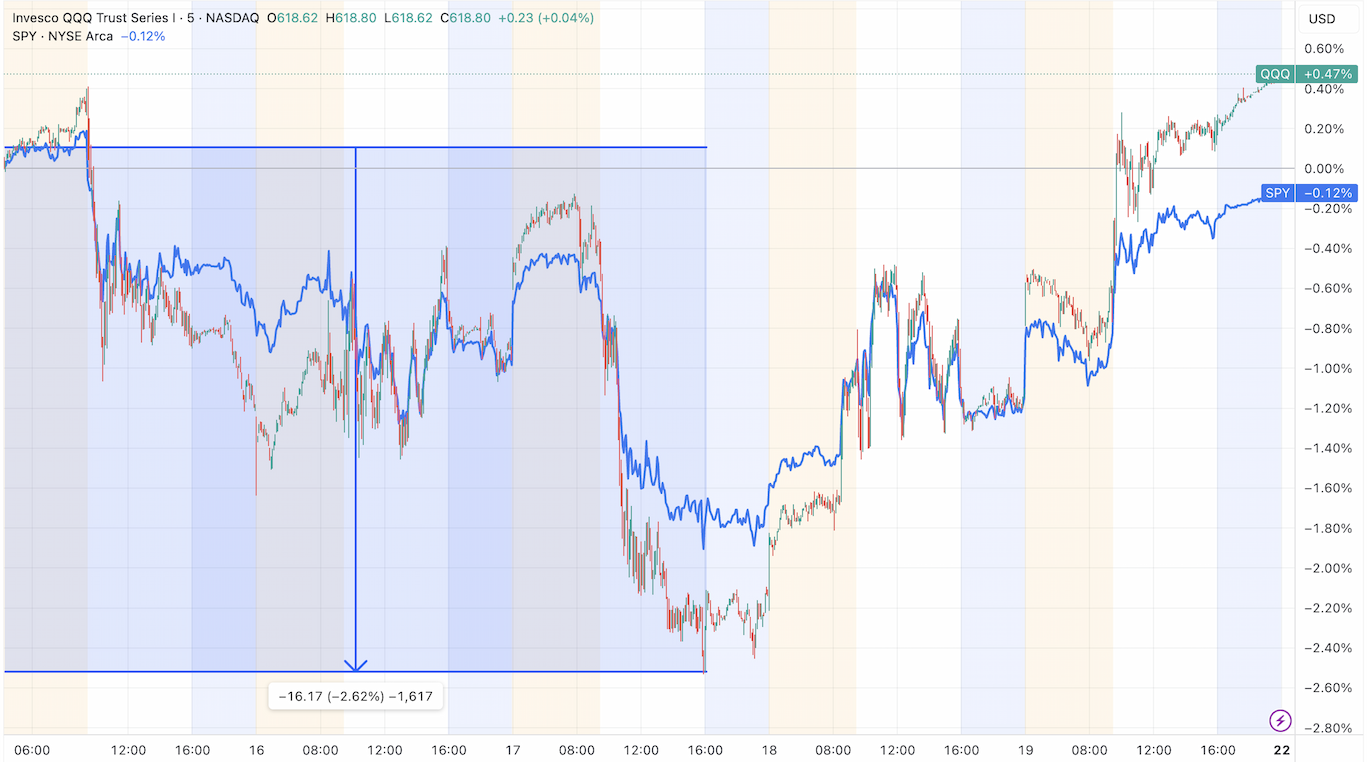
Taken together, this week’s action suggests markets are no longer blindly pricing in AI euphoria. Investors are asking deeper questions about how these projects are financed—and which firms can weather tighter credit conditions without strain.
The rotation toward defensive sectors underscores that caution. Investors are still willing to take risk—but only selectively, and with an eye toward balance-sheet strength and near-term cash flow.
As long as macro uncertainties remain unresolved, expect this kind of under-the-hood sector divergence to continue—even if headline indices appear calm on the surface.
Join LevelFields now to be the first to know about events that affect stock prices and uncover unique investment opportunities. Choose from events, view price reactions, and set event alerts with our AI-powered platform. Don't miss out on daily opportunities from 6,300 companies monitored 24/7. Act on facts, not opinions, and let LevelFields help you become a better investor.

AI scans for events proven to impact stock prices, so you don't have to.
LEARN MORE