

A practical guide to stock alert platforms, outlining strengths, limitations, and ideal use cases for different trading styles.
Sectors & Industries
December 24, 2025


Table of Contents
Staying on top of market-moving events is crucial for investors. A variety of services and platforms provide alerts for key stock events – from earnings reports and dividend announcements to insider trades and analyst rating changes – delivered via mobile apps, desktop platforms, or email. Below we compare top alert services (both free and paid), highlighting what alert types they cover, their format (app, web, email), and their strengths and weaknesses.
This will help you choose the right mix of tools to never miss important events like earnings releases, insider transactions, dividends, stock splits, M&A news, analyst upgrades/downgrades, or real-time price spikes.
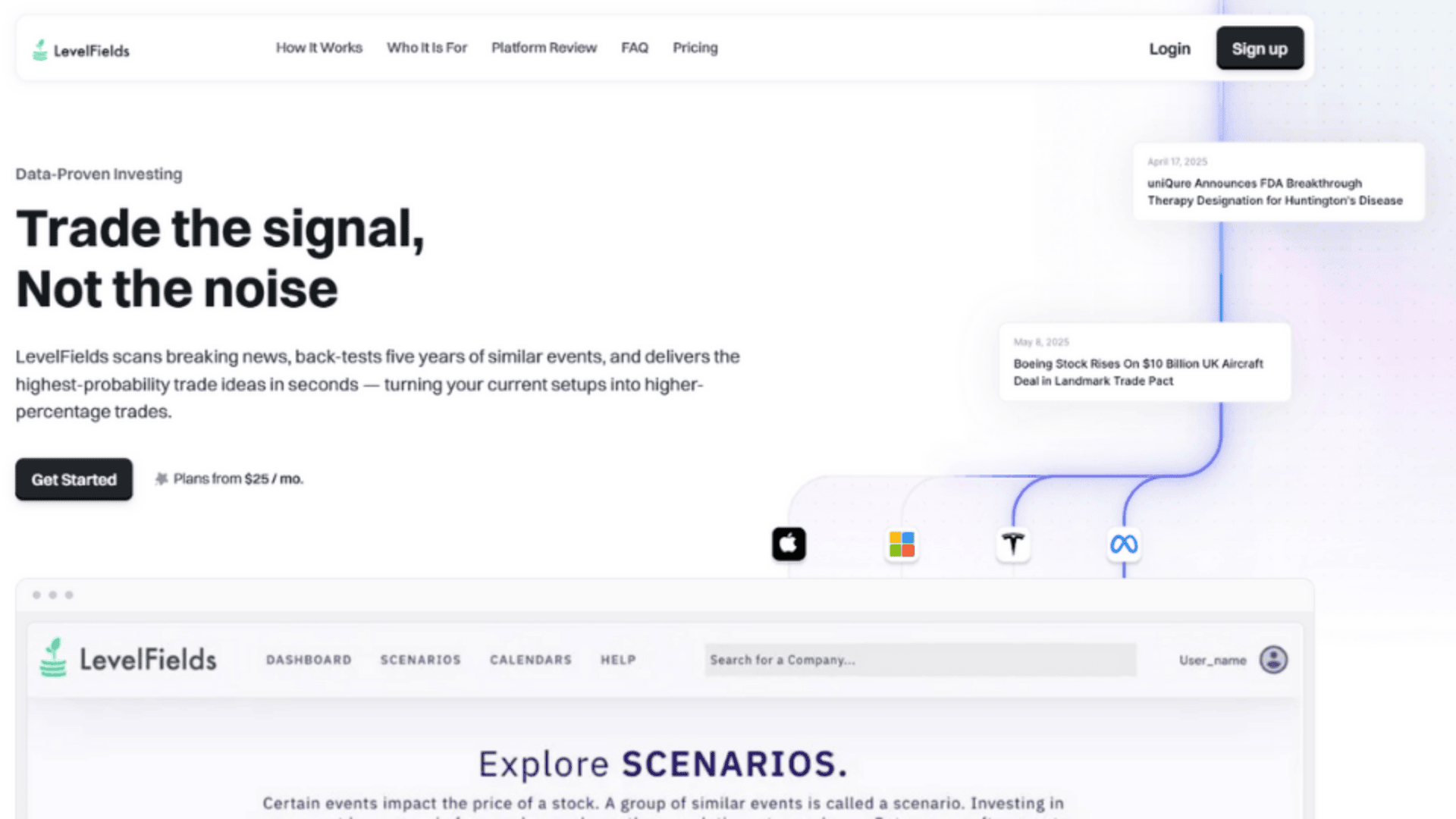
LevelFields focuses on alerting investors to specific corporate and regulatory events that have historically moved stock prices, rather than broad news flow or purely technical triggers. The platform continuously scans filings, press releases, and official disclosures to surface events such as buybacks, earnings surprises, dividend changes, executive departures, FDA decisions, layoffs and more.
What differentiates LevelFields in practice is that alerts are paired with historical outcome data. When an alert is triggered, users can see how similar events affected the same stock — or comparable companies — in the past. This adds an extra layer of context that helps investors judge whether an event is likely to matter, rather than reacting to every headline equally.
Alerts are delivered in real time via web notifications, email, push alerts, or SMS, and the platform is designed to complement — not replace — charting tools or traditional news apps. While it is a paid service, it is often used alongside free platforms by investors who want earlier visibility into fundamental catalysts, particularly for swing trading or options strategies where timing around events matters.
Best suited for:
Investors and traders who prioritize event-driven signals and want historical perspective alongside alerts, rather than relying solely on price movement or general news coverage.
.png)
Yahoo Finance is one of the most widely used investing platforms, largely because it offers a solid set of alerts at no cost. Users can set notifications for price thresholds, percentage moves, unusual volume, earnings dates, and breaking news tied to their watchlists. Alerts are delivered through the mobile app, email, or web notifications, and are tightly integrated with Yahoo’s news feed.
A key strength of Yahoo Finance is accessibility. Alerts are easy to configure, coverage is broad across U.S. stocks, and explanations often accompany price moves in the form of related news articles. This makes it useful for investors who want to stay informed without managing complex settings.
Where Yahoo Finance is more limited is in event specificity. Alerts are mostly reactive — triggered by price movement or general news — and do not isolate corporate actions like insider transactions, buyback authorizations, or executive changes unless they surface as major headlines. For many investors, it works best as a baseline monitoring tool rather than a catalyst-focused system.
.png)
Seeking Alpha combines alerts with long-form analysis and is especially strong around earnings-related events. Investors receive notifications when companies release earnings, update guidance, declare dividends, or publish SEC filings. These alerts are often paired with earnings transcripts, analyst commentary, and opinion-driven articles.
The platform is particularly useful for investors who want interpretation alongside notification. Earnings alerts, dividend announcements, and valuation discussions are well-covered, and users can follow specific authors or analysts for updates.
However, the alert experience can become noisy, especially for users following many stocks. Alerts tend to reflect coverage availability rather than prioritizing which events historically move prices. Seeking Alpha excels at explanation and depth, but it is less focused on early detection or filtering events by historical market impact.
.png)
Benzinga Pro is designed for speed. It delivers real-time alerts for breaking news, analyst upgrades and downgrades, earnings releases, economic data, and market rumors. Many active traders rely on Benzinga Pro because headlines often appear there before reaching mainstream outlets.
The platform offers extensive customization, allowing users to filter alerts by ticker, sector, or event type. Audio squawk alerts and desktop notifications are popular among day traders who need immediate awareness without constantly watching screens.
Benzinga Pro’s strength is timeliness, not evaluation. Alerts focus on what just happened, leaving it to the user to decide whether the news is meaningful. It does not attempt to assess how similar events performed historically, which means it is most effective for experienced traders who already know how to contextualize news quickly.
Stock Alarm is a mobile-first alert app built around price and technical triggers. Users can configure alerts for price levels, percentage moves, volume surges, 52-week highs or lows, and technical indicators such as moving average crossovers or RSI thresholds. Alerts can be delivered via push notification, email, SMS, or even automated phone calls.
This flexibility makes Stock Alarm popular with traders who need precise, real-time notification when price conditions are met, including during pre-market and after-hours sessions.
What Stock Alarm does not attempt to do is explain why a move occurred. Alerts are purely condition-based, and users must rely on other platforms to identify the underlying catalyst. It is best used as a tactical execution tool rather than a source of fundamental insight.
.png)
TradingView is widely regarded as one of the most powerful charting platforms available. Its alert system allows users to create alerts based on price levels, indicators, trendlines, chart patterns, or custom Pine Script logic. Alerts run on cloud servers and are delivered across mobile, web, and email.
For technically driven traders, TradingView offers unmatched flexibility. Alerts can be as simple or as complex as needed, making it suitable for systematic and rules-based strategies.
That said, TradingView is intentionally technical in nature. While earnings dates and dividends may appear on charts, it does not generate alerts for corporate actions like insider trades, buybacks, leadership changes, or regulatory developments. As a result, it is typically paired with other platforms that handle fundamental or event-driven information.
Each alert platform serves a different role:
LevelFields quietly fills a narrower but distinct gap: filtering market events by historical impact, rather than alerting on everything that moves or gets published.
For investors who want to understand which events tend to matter — not just when something happens — that distinction can be useful when combined with more traditional alert tools.
The best event management tool depends on what kind of events you’re tracking.
In investing, “event management” is less about scheduling and more about detecting, categorizing, and reacting to catalysts in real time.
Google Alerts is useful for general monitoring, but it has limitations for investing. It is:
Many investors use more specialized tools that focus on structured market events rather than raw headlines. Platforms like LevelFields are often preferred because they detect specific corporate actions and show how similar events historically affected stock prices, instead of just delivering articles.
For stock market event tracking, commonly used platforms include:
Professional and active investors typically combine at least two tools—one for price and execution, and another for event detection and context.
There is no single best app for stock alerts; it depends on the alert type:
Apps that filter alerts by event significance, rather than sending notifications for every headline or price tick, tend to be more effective for decision-making.
The 7% rule is a simple risk-management guideline that suggests selling a stock if it falls 7% below your entry price. The goal is to prevent small losses from turning into large drawdowns. While not universally used by professionals, it is popular among newer traders because it enforces discipline and limits emotional holding of losing positions.
There is no universal No. 1 trading app. The best trading app depends on:
Most serious investors don’t rely on a single app. They use a brokerage app for execution, paired with research, alert, or event-tracking platforms to inform decisions before trades are placed.
If you want, I can:
Join LevelFields now to be the first to know about events that affect stock prices and uncover unique investment opportunities. Choose from events, view price reactions, and set event alerts with our AI-powered platform. Don't miss out on daily opportunities from 6,300 companies monitored 24/7. Act on facts, not opinions, and let LevelFields help you become a better investor.

AI scans for events proven to impact stock prices, so you don't have to.
LEARN MORE