


.png)

L2 Weekly Stock Market News Analysis
March 1st, 2026

TLDR:
February ended with markets navigating two major forces: Middle East conflict and the first real signs of AI-driven economic disruption. Rising tensions around Iran pushed energy risk back into focus, while layoffs and earnings reinforced that AI is shifting from investment story to real economic force.
Geopolitical tensions escalated sharply after U.S. and Israeli strikes on Iran and attacks on shipping near the Strait of Hormuz — which carries roughly 20% of global oil supply. Shipping has slowed and vessels have been attacked near the strait, raising the risk of tighter energy supply and higher oil prices. Markets typically react first through oil and volatility, making energy flows the key variable to watch.
At the same time, AI moved from theory into real-world impact. Block (SQ) announced plans to cut about 4,000 employees as part of an AI overhaul, with CEO Jack Dorsey saying in a post on X that a smaller team using AI could operate more efficiently. The stock surged on the news while credit-sensitive companies like American Express (AXP), Capital One (COF), and Synchrony (SYF) fell as investors weighed the risk of white-collar job disruption. IBM also came under pressure after new AI tools threatened parts of its legacy consulting business, showing how quickly AI can challenge established revenue streams.
Sector performance reflected a cautious market. Utilities (XLU) led with +2.32%, followed by Communication Services (XLC) +1.37% and Consumer Staples (XLP) +1.36%, showing continued demand for defensive exposure. Technology (XLK) rose +0.57%, while Energy (XLE) was the only sector to decline at –0.24% despite rising geopolitical tensions. The pattern suggested stability rather than strong risk-taking.
Nvidia’s earnings remained the key test for AI demand. The company reported another major beat with revenue up 73% year over year and guidance far above expectations, confirming that demand for AI compute remains extremely strong. But the stock struggled after the report, showing that expectations remain high and investors are increasingly focused on competition, China exposure, and returns on AI spending.
Looking ahead, markets will focus on the February jobs report, ISM surveys, and retail sales, which will shape expectations for Federal Reserve policy. Broadcom and Costco earnings will also provide signals on AI investment and consumer demand — two themes likely to drive markets in the weeks ahead.
Iran Conflict and Strait of Hormuz Disruptions
Over the weekend, the U.S. and Israel launched major strikes across Iran targeting military and leadership sites. Iran’s Supreme Leader Ayatollah Ali Khamenei was killed in the attacks and replaced by an interim leadership council led by senior cleric Alireza Arafi, marking a major shift in the country’s leadership. Iran responded with missile and drone attacks across the region, and the conflict now appears likely to continue rather than end quickly.
The biggest economic risk comes from disruption in the Strait of Hormuz, the most important energy shipping route in the world. Iranian Revolutionary Guard transmissions warned vessels that no ships are allowed to pass through the strait, and shipping activity has largely halted. Multiple commercial vessels have already been attacked near the strait, with at least two ships struck by projectiles and another experiencing a nearby explosion. Tankers and LNG vessels have delayed or avoided transit, shipping insurers have raised prices or canceled policies, and many ships have reversed course or dropped anchor outside the entrance.
Even without a formal legal declaration, shipping behavior indicates the Strait is now effectively closed or heavily restricted, tightening global supply immediately.
The Strait of Hormuz carries a large share of global trade:
- Crude oil and petroleum: About 20% of global oil consumption (~20 million barrels per day) passes through the strait from producers such as Saudi Arabia, Iraq, Kuwait, UAE, and Iran.
- Liquefied natural gas: About 20–25% of global LNG exports, mainly from Qatar.
- Petrochemicals and chemicals: Industrial materials made from oil and natural gas move through this route. These include plastics, synthetic fibers, industrial chemicals, packaging materials, and industrial resins used in manufacturing, construction, electronics, and consumer goods.
- Nitrogen fertilizer: Roughly one-quarter of globally traded nitrogen fertilizer passes through the strait, making it critical for global food production.
- General cargo: Industrial goods and raw materials also move through the region.
More than 80% of oil and gas shipments through Hormuz go to Asia, especially China, India, Japan, and South Korea.
Even moderate disruption can affect global supply because shipping, insurance, and transit delays reduce available volumes before any official closure occurs.


What This Means for Markets
Markets are likely to react first through oil prices and shipping disruption, because energy supply moves immediately when shipping slows. Oil could move toward $80–$100 per barrel if disruption continues.
Even though OPEC+ agreed to increase output by about 206,000 barrels per day, the increase is small relative to global demand and does little if ships cannot move normally.
Historical market reactions suggest geopolitical shocks often cause short-term volatility rather than lasting declines.
During the January 2020 Soleimani strike:
- Oil rose about 0.5% in one day
- Gold rose about 0.9%
- The S&P 500 rose about 0.4%
- The VIX volatility index rose about 4.4 points before stabilizing
- 10-year Treasury yields initially fell before recovering
During the June 2025 Israeli strikes on Iran:
- Oil initially surged 11.7% the week before, then fell slightly after the event
- Gold rose about 3.7% before the strikes
- The S&P 500 dipped slightly before stabilizing
- The VIX jumped 24% before quickly falling
- Treasury yields fell first and then rebounded
These examples show that geopolitical shocks often create short-term spikes in oil and volatility, but markets can stabilize if energy flows continue.
Potential Beneficiaries
Energy producers
Higher oil prices directly benefit major producers:
- Exxon Mobil (XOM)
- Chevron (CVX)
Because about 20% of global oil supply moves through the Strait of Hormuz, even moderate disruption can tighten supply and push crude prices higher.
LNG exporters
Roughly 20–25% of global LNG exports pass through Hormuz, so shipping disruption can tighten global gas supply and raise LNG prices.
Potential beneficiaries include:
- Cheniere Energy (LNG) – Major U.S. LNG exporter that benefits if global LNG prices rise.
- Tellurian (TELL) – LNG developer leveraged to higher long-term LNG prices.
- NextDecade (NEXT) – LNG export projects tied to global gas demand.
If Middle East shipments slow, buyers must compete for replacement cargoes, which typically pushes LNG prices higher.
Defense companies
A longer conflict increases demand for weapons and replenishment:
- Lockheed Martin (LMT)
- RTX Corp (RTX)
- Northrop Grumman (NOC)
Extended operations typically lead to increased orders and replenishment of munitions and defense systems.
Fertilizer producers
Disruptions to nitrogen fertilizer shipments could tighten global supply:
- CF Industries (CF)
- Nutrien (NTR)
Because roughly one-quarter of globally traded nitrogen fertilizer passes through Hormuz, shipping disruption can affect agricultural supply and food production costs.
Shipping companies
Higher shipping risk and insurance costs can raise freight rates:
- Star Bulk Carriers (SBLK)
- ZIM Integrated Shipping (ZIM)
Shipping insurers have already raised prices and some companies have suspended Hormuz transit, which increases transportation costs and freight rates.
Potential Pressure Points
Airlines and transportation
Higher fuel costs would pressure margins:
- Delta Air Lines (DAL)
- United Airlines (UAL)
Fuel is one of the largest costs for airlines, so rising oil prices directly affect profitability.
Import-heavy companies and supply chains
Higher shipping and energy costs increase costs across global supply chains. Delays through Hormuz can raise transportation costs and reduce inventory availability.
The Key Market Variable
The most important question for markets is how long disruption in the Strait of Hormuz lasts.
If shipping normalizes quickly, markets may treat the conflict as a short-term shock similar to past Middle East events.
If disruption continues, higher oil prices, LNG prices, fertilizer costs, and shipping expenses could push inflation higher and increase market volatility across sectors.

AI Moves From Hype to Headcount
For the past year, the debate around AI has focused on chips and valuations. Now the impact is starting to show up in jobs and entire business models.
The clearest example came this week when Block (SQ) announced it would cut 4,000 employees — nearly half its workforce — while investing heavily in artificial intelligence tools. CEO Jack Dorsey said in a post on X that a smaller team using AI could operate more efficiently, and the stock surged following the announcement.

The news also added pressure across parts of the financial sector. Credit-sensitive stocks like American Express (AXP), Capital One (COF), and Synchrony (SYF) fell as investors worried that large-scale AI-driven layoffs could weaken white-collar employment and consumer credit demand.
This is exactly the scenario many workers feared: large companies cutting jobs specifically because AI can replace them.
At the same time, AI is starting to threaten entire business models — not just individual jobs.
IBM is a clear example. Shares have fallen sharply after Anthropic released Claude Code, an AI tool that can automate parts of COBOL modernization work — a long-standing IBM consulting business. The stock is down roughly 20–25% in the last month, showing how quickly AI tools can threaten established revenue streams.
Six areas exposed to automation
These roles depend heavily on repetitive digital work:
- Customer service / call centers – AI chat and voice agents
Five9 (FIVN), NICE (NICE) - HR & recruiting – resume screening and hiring workflows
Workday (WDAY), ADP (ADP) - Accounting & bookkeeping – document processing and reconciliation
Intuit (INTU) - IT services & outsourced tech support – routine code maintenance and ticket handling
Cognizant (CTSH) - Legal and document workflows – contract and document analysis
Thomson Reuters (TRI) - Consumer credit operations – automated underwriting and servicing
Discover (DFS)
The pattern is simple: if the job is rules-based and done on a screen, AI can likely handle it.
This is the first real evidence that AI displacement is moving from theory into practice.
Last's Weeks Sector Winners & Losers
Sector performance was modest overall, with defensive sectors leading while energy lagged.
Utilities (XLU) led the market, rising +2.32%, followed by Communication Services (XLC) +1.37% and Consumer Staples (XLP) +1.36%, showing continued demand for steadier and defensive areas of the market.
Real Estate (XLRE) gained +1.00%, while Consumer Discretionary (XLY) +0.70%, Financials (XLF) +0.67%, and Information Technology (XLK) +0.57% posted moderate gains in a generally stable week.
More cyclical sectors lagged. Materials (XLB) rose only +0.32% and Industrials (XLI) gained +0.20%, while Health Care (XLV) was nearly flat at +0.10%.
Energy (XLE) was the only sector to decline, falling –0.24% despite rising geopolitical tensions.
The takeaway wasn’t strong risk-taking — it was stability. Investors favored defensive sectors like utilities and staples while keeping exposure across the broader market, suggesting a cautious but steady environment rather than a full risk-on move.

Upcoming Events This Week
This week will focus on jobs, business activity, and consumer spending, all of which will shape expectations for Federal Reserve policy.
The February jobs report will be the main event, with hiring expected to slow to about 60,000 new jobs and unemployment holding near 4.3%. Investors will watch closely for signs the labor market is cooling enough to support future rate cuts.
Markets will also track ISM manufacturing and services data for signs of economic momentum, along with retail sales, which are expected to show slightly weaker consumer spending.
The key question for markets: Is growth slowing enough to bring rate cuts closer without signaling a recession?
On the corporate side, Broadcom and Costco earnings will provide insight into AI spending and consumer demand, two themes that have driven markets this year.


LevelFields AI Stock Alerts Last Week
Rocky Brands (RCKY) +38% — Earnings Beat and New Buyback
Rocky Brands jumped 38% in one day after reporting strong Q4 results and announcing a new $7.5M share repurchase program, signaling confidence in the company’s outlook.Q4 revenue rose 9.1% to $139.7M, while EPS increased to $0.86 ($0.94 adjusted) and net income climbed 36% YoY. Strong direct-to-consumer sales (+30.8%) helped drive the results.The earnings beat combined with the new buyback boosted investor confidence and drove the sharp move higher.
Larimar Therapeutics (LRMR) +31% — Breakthrough Therapy Designation
Larimar jumped 31% in one day after the FDA granted Breakthrough Therapy Designation to its lead drug nomlabofusp, a potential treatment for Friedreich’s ataxia.The designation could speed up approval, with the company planning a BLA submission in June 2026 and a potential U.S. launch in 2027 if approved. Friedreich’s ataxia affects roughly ~5,000 patients in the U.S. and ~15,000–20,000 globally, creating a rare-disease market potentially worth $1B+ annually if an effective therapy is approved.The regulatory progress strengthened confidence that the therapy could become the first disease-modifying treatment for the disease, driving the sharp move higher.
Nvidia (NVDA) — Blowout Earnings but Stock Fades
Nvidia reported another massive earnings beat, but the stock initially jumped and then faded back toward flat, showing that expectations remain extremely high.
Key results:
- EPS: $1.62 vs $1.53 expected
- Revenue: $68.1B (+73% YoY) vs $65.9B expected
- Data center revenue: $62.3B (+75% YoY) — the main growth driver
- Free cash flow: $34.9B, more than double last year
- Gross margin: ~75%
Guidance was even stronger:
- Next-quarter revenue: about $78B midpoint vs $72.8B expected
- Margins expected to stay around ~75%
- Nvidia said it has secured enough supply capacity for multiple quarters.
Demand remains extremely strong, with CEO Jensen Huang saying enterprise AI adoption and agentic systems are accelerating rapidly. Sovereign AI demand has also surged, with government-related business more than tripling this year.
However, the stock struggled to hold gains after the call as investors focused on competition risks and limited detail around future growth, especially as Chinese competitors continue to improve.
China also remains a wildcard. Nvidia’s guidance does not assume meaningful China data-center revenue, even though limited shipments may resume.

Introducing the LevelFields Portfolio Tracker
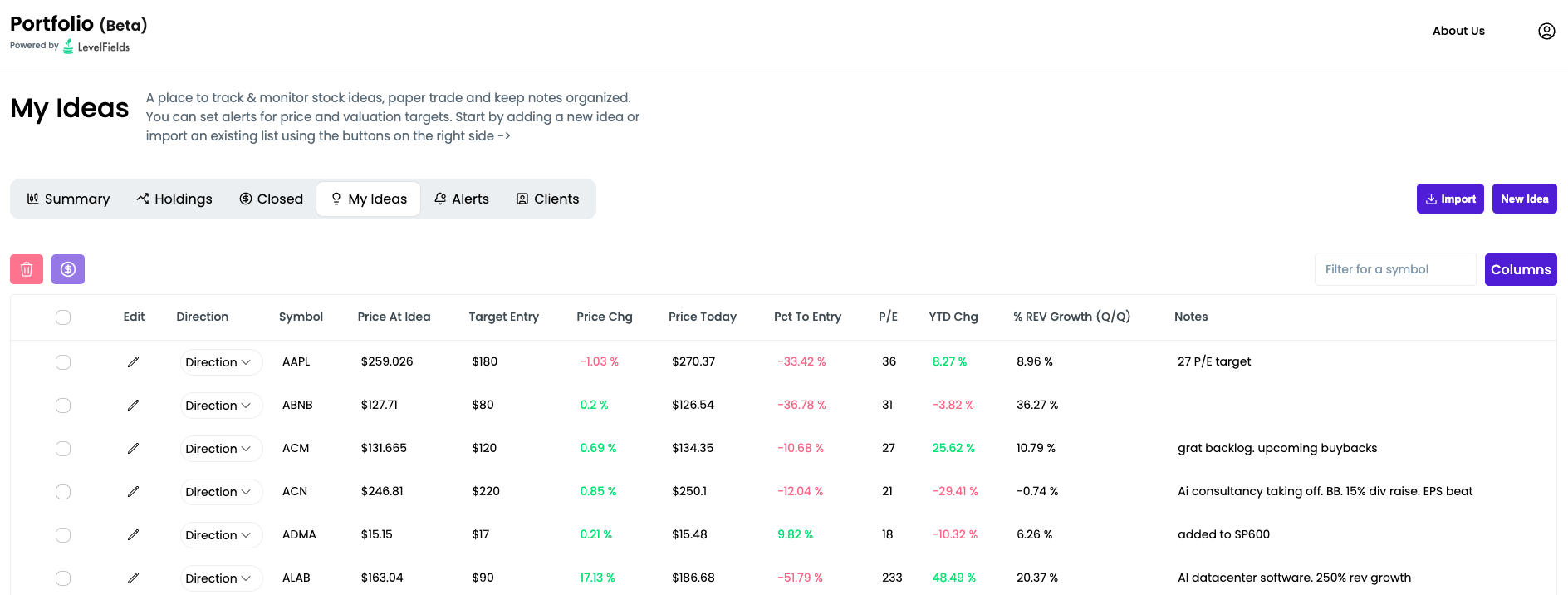
We’ve just launched the new LevelFields Portfolio platform — a centralized dashboard built for active investors and wealth managers to track their trades, organize trade ideas, and monitor real or prospective portfolios.
We've replaced Excel and Google Sheets trade tracking with software that updates as prices and valuations of stocks change, so you don't lose money by missing great entry and exit points.
You can sign up for free!
What it does:
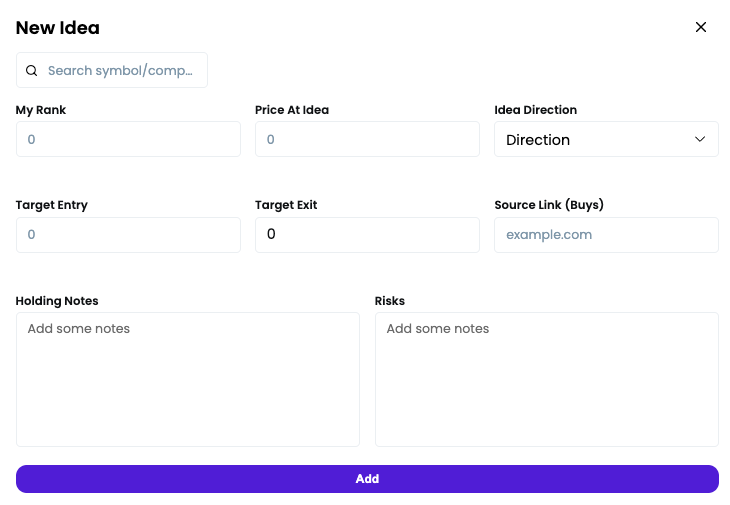
- Lets you add both real positions and idea-stage trades into one unified portfolio.
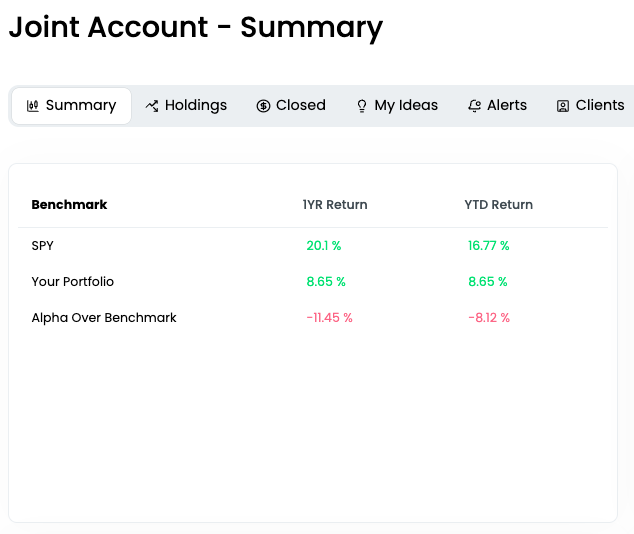
- Tracks allocation, profit/loss, KPIs, P/E, price targets, and thesis notes in one place.
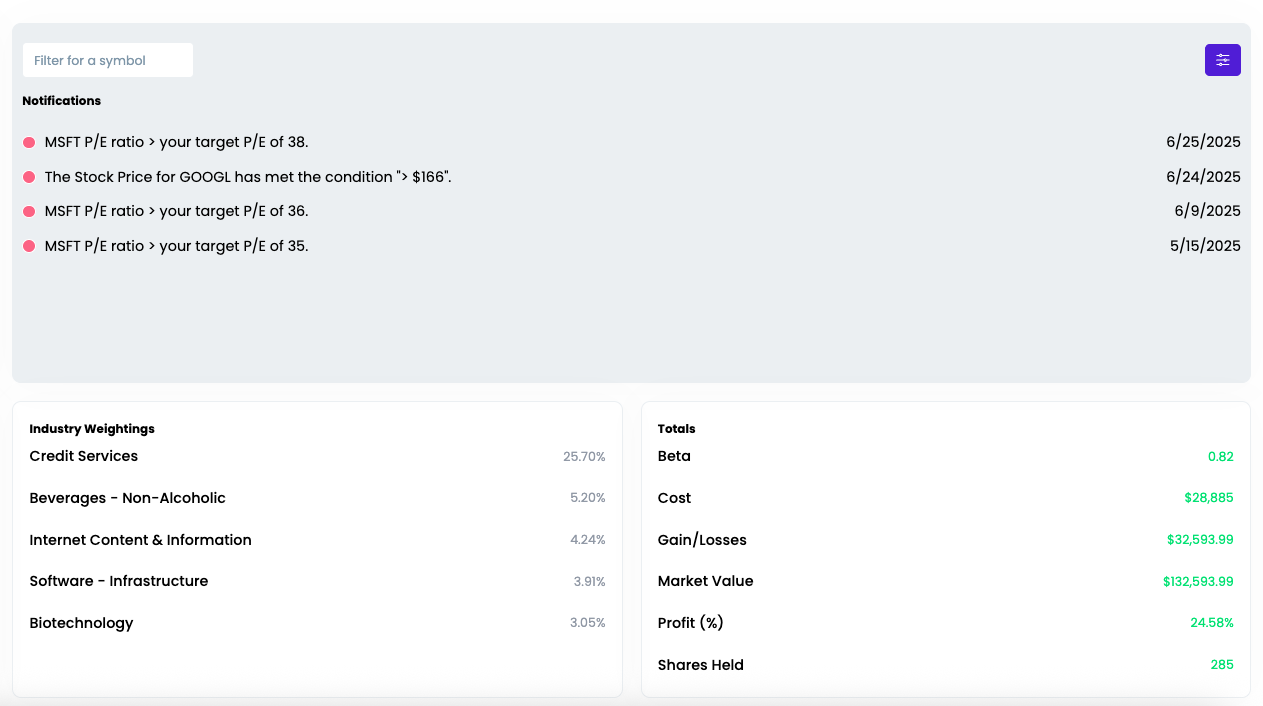
- Allows you to set real-time alerts on valuation changes, price moves, and price targets using bulk editing (e.g. one alert for all holdings).
- Lets you toggle any ticker between “Idea → Holding → Closed” while preserving the original trade thesis and exit notes.
- Designed for traders, advisors, and fund managers who need a live, organized view of positions + rationale, not just a static spreadsheet of tickers.
- Import CSV file of existing ideas, notes, and portfolio holdings for a quick start
- Keep track of reasons you bought and sold to analyze your performance and for compliance
- Design your own model portfolios based on allocations, sector, and industry

.png)
How to use LevelFields for Options Trading
Tracking Stocks Without Spreadsheets
The Truth About Dividend Stocks
What's LevelFields' Premium Membership Provide?

This is not financial advice. All information represent opinions only for informational purposes. Given the vast number of stocks we cover in these reports, assume staff covering stocks have positions in stocks discussed.
Have feedback or a request for specific data? Drop us a note at support@levelfields.ai