

CPI, PPI, retail sales, and AI infrastructure earnings headline a pivotal week for markets and Federal Reserve policy.
Sectors & Industries
August 10, 2026


Table of Contents
Washington’s campaign to reduce U.S. dependence on Chinese critical materials accelerated again this week.
The administration announced billionsof dollars across batteries, rare earths, scandium, magnets, bauxite, boron, and other strategic materials. This builds on a much broader effort that has already included government loans, equity stakes, price floors, long-term purchase agreements, tariffs, and defense contracts.
The goal is simple: reduce China’s leverage over the materials needed to build weapons, batteries, semiconductors, AI infrastructure, and robots.
The effort has been building for more than a year. What is changing now is the scale of capital being deployed and the number of supply chains Washington is willing to support directly.
Critical materials sit underneath nearly every major investment theme in the market.
Rare-earth magnets power missile systems, drones, EV motors, industrial machinery, and humanoid robot actuators. Graphite and lithium are essential to batteries. Scandium strengthens lightweight alloys used in aircraft. Germanium is used in infrared sensors and advanced electronics. Boron is used in magnets, semiconductors, nuclear applications, and defense.
AI is making the problem more important because demand is now coming from both sides of the technology stack.
Data centers require batteries, power equipment, semiconductors, and networking infrastructure. Physical AI requires motors, actuators, batteries, and large quantities of permanent magnets.
A humanoid robot may require roughly 3.5–4 kilograms of rare-earth magnets, potentially more magnetic material than an EV motor.
Meanwhile, defense demand is rising at the same time as the U.S. works to rebuild missile and air-defense inventories while reducing reliance on Chinese suppliers. This week, talks were revealed between Lockheed Martin (LMT) and NioCorp (NB), Teck Resources (TECK), and 5N Plus (VNP) to secure scandium and germanium supplies outside China, showing how policy pressure is beginning to translate into real procurement decisions.
The result is that defense, AI, robotics, batteries, and electrification are increasingly competing for many of the same materials.
The easiest way to understand the opportunity is:
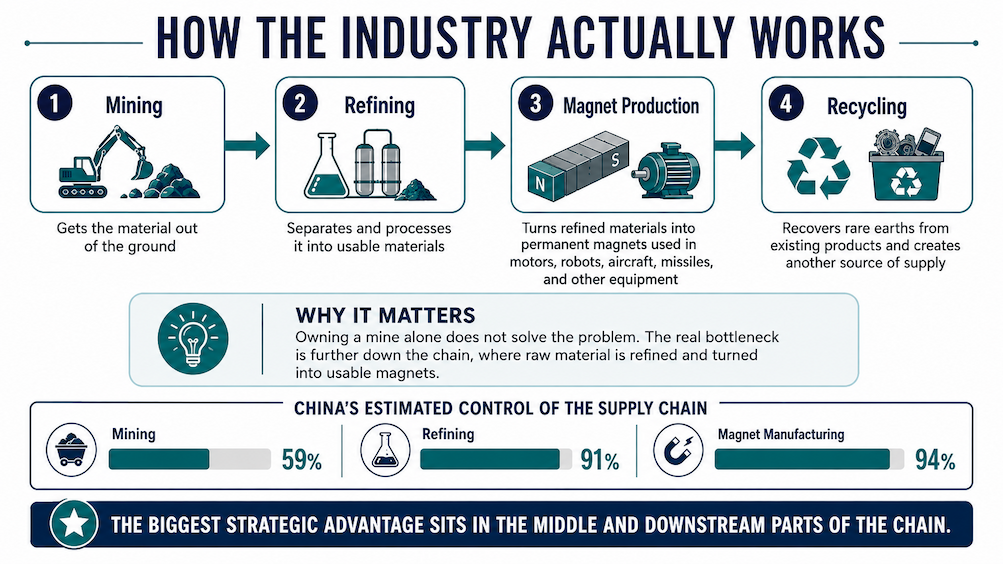
Mining → Refining → Magnet Production → Recycling
Mining gets the material out of the ground.
Refining separates and processes it into the specific materials manufacturers need.
Magnet production turns those refined materials into permanent magnets used inside motors, robots, aircraft, missiles, and other equipment.
Recycling creates another source of supply by recovering rare earths from existing products.
The important point is that simply owning a mine does not solve the problem.
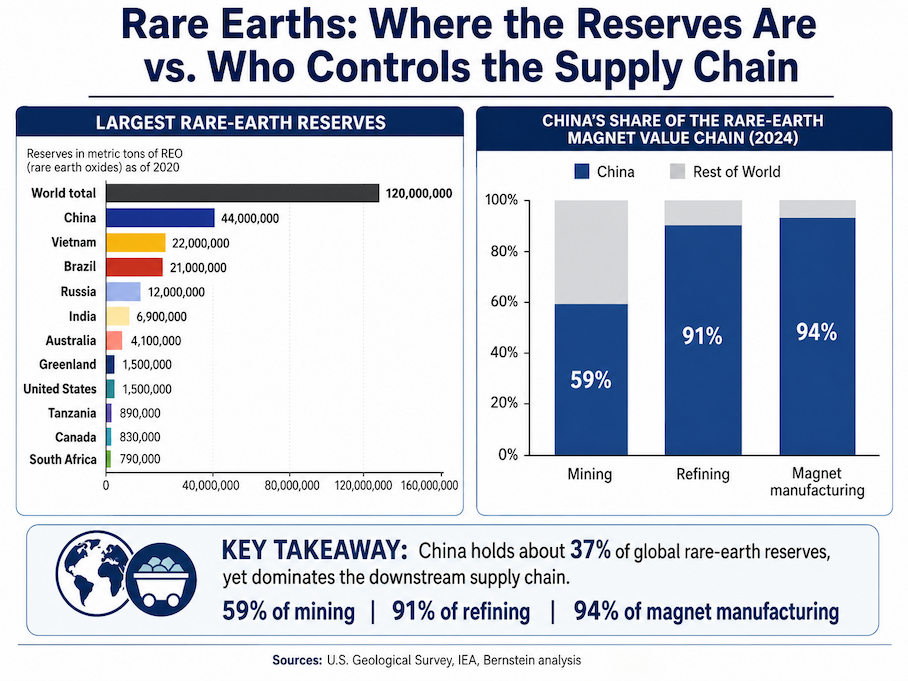
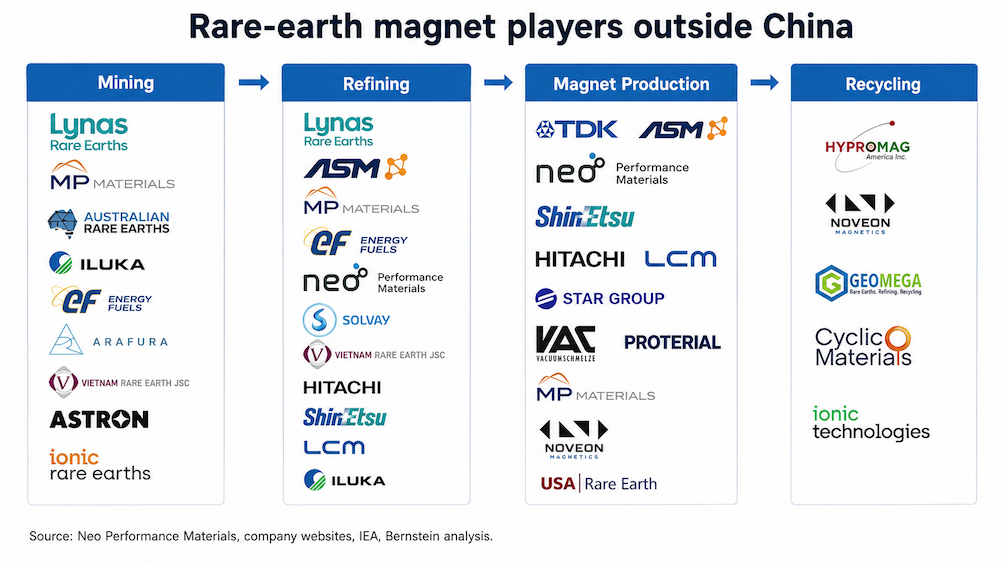
China is estimated to control roughly 59% of magnet rare-earth mining, 91% of refining, and 94% of magnet manufacturing. Its biggest advantage therefore sits in the middle and downstream portions of the supply chain, where raw material becomes something manufacturers can actually use.
That is why vertically integrated companies are strategically important. MP Materials (MP), for example, already mines, separates, and refines rare earths at Mountain Passwhile expanding domestic magnet production.
This is not limited to this week’s announcements. The government has been steadily building positions across different parts of the supply chain.
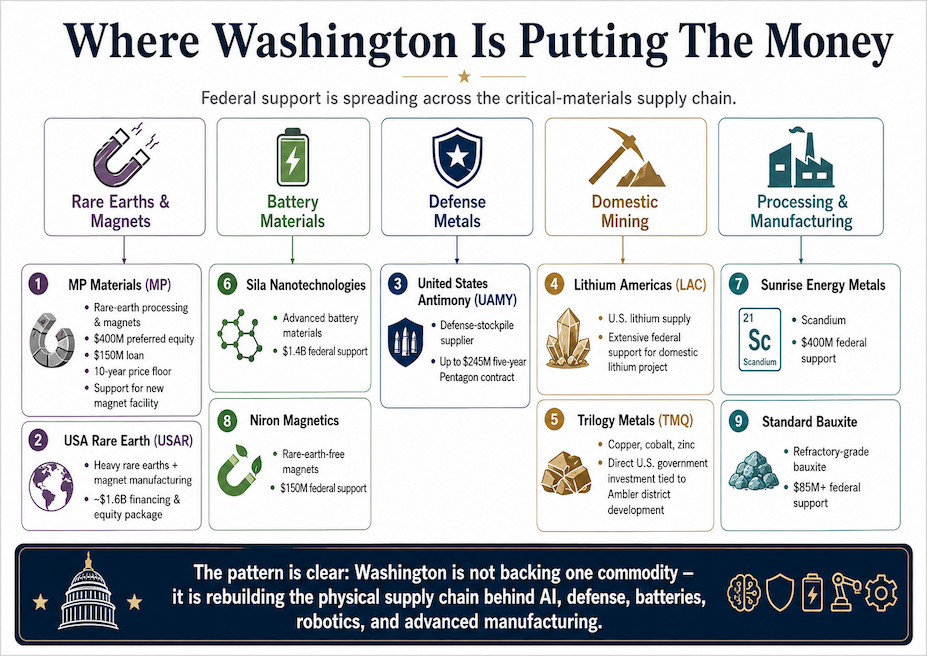
MP Materials (MP) receiveda multibillion-dollar Pentagon-backed package supporting rare-earth processing and magnet manufacturing. The agreement includes a $400 million preferred-equity investment, a $150 million loan, a 10-year price floor, and support for a new magnet facility.
USA Rare Earth (USAR) received a roughly $1.6 billion government financing and equity package to advance its heavy rare-earth project and domestic magnet manufacturing.
United States Antimony (UAMY) secured a five-year Pentagon contract worth up to $245 million to supply antimony for the national defense stockpile.
Lithium Americas (LAC) hasreceived extensive federal supportfor development of its U.S. lithium project, one of the most strategically important domestic battery-material projects. The company also has backing from General Motors, which has invested in the project and signed agreements to help secure a domestic lithium supply chain for EV batteries.
Trilogy Metals (TMQ) received a direct U.S. government investment tied to development of Alaska’s Ambler mining district, which contains copper, cobalt, zinc, and other strategic minerals.
This week added another wave of support, including $1.4 billion for Sila Nanotechnologies, $400 million for Sunrise Energy Metals, $150 million for Niron Magnetics, and more than $85 million for Standard Bauxite.
The pattern is clear: Washington is not picking one commodity. It is trying to rebuild the entire physical supply chain behind AI, defense, batteries, robotics, and advanced manufacturing.
The key date for this trade is November 10, 2026.
China temporarily suspended several export controls on rare earths, lithium-battery materials, graphite, gallium, germanium, antimony, and related processing technologies as part of the U.S.-China trade truce.
That suspension expires November 10.
This does not mean exports automatically stop the next day, but if negotiations deteriorate, previously suspended restrictions could return.
The market will likely move before the deadline. Any sign that talks are breaking down could quickly increase the value of companies producing strategic materials outside China.
Our approach is therefore to own companies where Washington is already removing financing, processing, or supply bottlenecks rather than simply funding speculative exploration.
WWR is currently the clearest U.S. graphite trade.
Shares nearly doubled Friday after the U.S. Export-Import Bank committed $25 million to help complete its Alabama graphite facility.
Graphite is the primary material used in lithium-ion battery anodes, yet the U.S. currently has no meaningful domestic natural-graphite production.
More importantly, the federal financing removes a major funding risk.
The stock is extended after Friday's move, so we would look for a better entry rather than chase, but WWR is our preferred higher-risk trade.
UUUU targets what may be the most important bottleneck: domestic refining and processing.
Opening U.S. mines does little good if the material still needs to be sent overseas before manufacturers can use it.
Energy Fuels participates in both mining and rare-earth processing and has received a $725 million conditional federal loan tied to domestic rare-earth development.
If China threatens renewed export controls, processing capacity could become even more valuable.
MP remains one of the highest-quality way to own the theme.
It already operates Mountain Pass, refines rare earths domestically, and is expanding into U.S. magnet manufacturing.
Pentagon financing, a long-term price floor, and magnet purchase commitments substantially reduce the risks faced by most mining companies.
UAMY gives investors direct exposure to antimony, which is used in munitions, batteries, and other defense applications.
The company has a sole-source Pentagon contract worth up to $245 million to supply antimony for the U.S. defense stockpile.
That gives UAMY a much clearer demand catalyst than simply betting on higher commodity prices.
AMPX gives direct exposure to the battery side of the reshoring theme.
The company develops high-energy-density lithium-ion batteries using silicon-based anodes, the same broader battery technology area Washington is now backing through its $1.4 billion commitment to Sila Nanotechnologies.
AMPX was not a direct recipient of this week’s funding, but it fits the same strategic need: building advanced battery capacity outside China for defense, drones, aviation, and other high-performance applications.
Unlike a mining project that may take years to reach production, AMPX already sells batteries, giving it more immediate exposure to rising demand for domestically sourced advanced battery technology.
Join LevelFields now to be the first to know about events that affect stock prices and uncover unique investment opportunities. Choose from events, view price reactions, and set event alerts with our AI-powered platform. Don't miss out on daily opportunities from 6,300 companies monitored 24/7. Act on facts, not opinions, and let LevelFields help you become a better investor.

AI scans for events proven to impact stock prices, so you don't have to.
LEARN MORE