


.png)

L2 Weekly Stock Market News Analysis
February 15th, 2026

TLDR:
Markets move deeper into February with leadership continuing to rotate — not out of equities, but away from crowded AI growth and toward value, energy, and companies delivering current earnings. The shift reflects discipline rather than panic. Investors are favoring businesses with visible cash flow, steadier demand, and clearer return profiles while questioning how quickly massive AI spending will translate into profits.
Sector performance reflected that rotation. Utilities (XLU) led the five-day move, up +4.99%, followed by Materials (XLB) +4.61%, Real Estate (XLRE) +3.98%, Energy (XLE) +3.39%, Consumer Staples (XLP) +2.63%, Industrials (XLI) +2.60%, and Information Technology (XLK) +2.64%. Health Care (XLV) edged up +0.75%. Lagging were Consumer Discretionary (XLY) –1.17%, Communication Services (XLC) –1.35%, and Financials (XLF) –3.00%. The message was clear: money flowed into steady, asset-heavy sectors and away from more cyclical or sentiment-driven areas.
The rotation came alongside softer inflation data. Headline CPI slowed to 2.4% year over year in January, below expectations and the lowest since May, driven by easing energy prices and declines in used vehicles. Core inflation fell to 2.5%, its lowest since March 2021, while monthly CPI rose just 0.2%. The trend supports a gradual cooling in price pressures, shifting focus back to earnings and balance sheets rather than renewed rate concerns.
Earnings remain central to the narrative. Companies showing strong cash generation, buybacks, dividends, or backlog visibility continue to outperform, while firms tied to heavy capital spending or longer-dated growth assumptions face tougher scrutiny. The market isn’t rejecting growth — it’s demanding proof.
Looking ahead, the focus shifts to the Federal Reserve minutes, Q4 GDP, core PCE inflation, and personal income and spending data. Globally, investors will watch Canadian inflation, European PMIs, and Japan’s GDP. Earnings from Walmart, Palo Alto Networks, Booking, Analog Devices, and others will further test whether leadership stays with stable, cash-producing businesses or shifts back toward growth.
From AI Excitement to Cash-Flow Reality
Markets didn’t just drift lower this week — leadership changed.
The Nasdaq finished modestly down, but beneath the surface investors continued pulling money out of crowded AI and software trades and rotating into companies with steadier earnings and clearer cash flow. This follows the forced selling episode that began in crypto, spread into software, and exposed just how crowded the AI trade had become.
The real shift isn’t about AI demand disappearing. It’s about how the AI story has changed.
What started as a high-margin software growth theme has become a massive construction effort. The largest tech companies are now building data centers at a historic pace. Alphabet guided to roughly $175–$185 billion in 2026 capital spending. Amazon signaled roughly $200 billion. Across hyperscalers, total capex in 2026 is expected to approach $700–$740 billion.
That level of spending changes the financial picture.
When companies commit that much to data centers, chips, networking equipment, cooling systems, and power infrastructure, it absorbs a huge share of operating cash flow. Instead of returning capital to shareholders, they’re reinvesting nearly all of it. In some cases, free cash flow flattens. Debt issuance rises. Financial flexibility narrows.
Investors are responding accordingly. Alphabet is down roughly 8% over the past month. Amazon has fallen about 16% this month alone. The issue isn’t collapsing demand — AWS and cloud growth remain strong — it’s the scale and timing of the spending.
The question investors are asking is simple: how long until this spending turns into higher profits?
Cloud demand remains real. AI usage is growing. But when spending rises faster than near-term revenue, it pressures margins and pushes out the payoff timeline. In a market where expectations were high and positioning was crowded, that shift matters.
This isn’t a collapse of the AI theme. It’s a repricing of patience. Investors are becoming less willing to fund open-ended spending plans without clearer evidence of near-term earnings growth.
And when capital tightens, money flows toward companies already generating steady cash — not those promising it further down the road.

Value Regains Control: Steady Earners Move Back Into Favor
The shift this week wasn’t random. It reflects a broader rotation that has been building for months.
After two years of growth stocks dominating, value stocks are trading at one of their widest discounts to growth in years on forward earnings and price-to-book. Long-only investors remain heavily overweight growth and underweight value. Crowding in large-cap tech is still elevated, while many steady, asset-heavy businesses remain underowned. That imbalance matters — especially as profit growth across the broader market is expected to improve this year.
One striking signal of this shift: Walmart is now trading at roughly double the forward P/E of Amazon.
For years, Amazon carried the premium multiple as the market’s preferred growth story. Now the higher valuation sits with Walmart — a company built around steady retail demand and consistent execution. That reversal says a lot about what investors currently value. Stability is commanding a premium.
We’re seeing signs of that preference play out across earnings.
Coca-Cola (KO) delivered steady full-year revenue growth and $7.4 billion in operating cash flow. Even with currency pressure and one-time charges, margins held up and earnings remained consistent. That reliability has helped support the stock as investors look for businesses where demand and cash generation are predictable.
Crocs (CROX) showed a similar pattern. Revenue may be flat looking forward, but the company generated about $700 million in operating cash flow, repurchased shares, reduced debt, and guided to solid earnings for 2026. In this market, strong cash flow and disciplined capital allocation are being rewarded more than ambitious growth projections.
Comfort Systems USA (FIX) may be one of the clearest example of what investors want right now. The company installs heating, cooling, and electrical systems in commercial buildings and industrial facilities — including data centers, hospitals, and manufacturing plants. It isn’t flashy. But it produces steady profits and builds backlog through signed contracts. Revenue and earnings rose sharply last quarter, and backlog reached a record $9.38 billion, representing years of work already secured.
FIX doesn’t trade on promises. It gets paid for completed projects. That consistency — not hype — has driven its long-term outperformance.
This isn’t about abandoning growth. It’s about leadership broadening. When the most crowded trades stall, capital looks for businesses with steady earnings, visible demand, and tangible results — and that’s exactly where money has started to flow.
AI Isn’t Over — Investors Just Want Proof (Power, Profits, and Who’s Actually Getting Paid)
The AI buildout hasn’t stopped. Electricity demand tied to data centers is still growing. What has changed is how investors are reacting. The market is no longer rewarding exposure to the theme — it’s rewarding companies that are clearly turning that demand into steady profits and cash flow.
Utilities are a good example of that shift. Duke Energy (DUK) and Portland General Electric (POR) both moved higher because their business model is built around predictable returns. When electricity demand rises — especially from industrial and data center customers — they invest in grid upgrades and earn an approved return on that spending. POR’s latest results showed industrial load growth driven by data centers and reaffirmed full-year earnings guidance, reinforcing that this demand is already flowing through to results. It’s not flashy growth, but it’s visible and dependable — exactly what investors are gravitating toward.
On the infrastructure side, Vertiv (VRT) shows what happens when AI demand converts directly into earnings. The stock jumped roughly 20% after reporting Q4 sales up 23% to $2.88B, a surge in orders, and backlog reaching $15B. The company generated about $910M of free cash in the quarter and guided to another step up in 2026. That combination — revenue growth, expanding margins, strong cash flow, and clear forward visibility — tells investors this isn’t just an AI narrative, it’s an operating machine producing real returns.
Power Solutions International (PSIX) fits the same pattern. Revenue rose 62% year over year to $203.8M and EPS climbed 60% to $1.20, supported by data center-related demand. The stock’s sharp move higher reflects the same principle: earnings momentum matters more than theme momentum.
Centrus (LEU), on the other hand, illustrates the other side of the market’s discipline. Even though it remains tied to the long-term nuclear power and energy security story supporting AI growth, the stock fell sharply because uranium revenue declined year over year and guidance suggests growth may level off in 2026. In this environment, being part of the AI-energy narrative is not enough. Investors want steady revenue growth, improving margins, and visible profitability now — not just long-term potential.
Last's Weeks Sector Winners & Losers
Sector leadership shifted again, reinforcing the rotation toward steadier, asset-heavy areas of the market.
Utilities (XLU) led, up +4.99%, followed by Materials (XLB) at +4.61%, and Real Estate (XLRE) at +3.98%. Energy (XLE) gained +3.39%, while Information Technology (XLK) rose +2.64% — but notably lagged the more defensive and real-economy sectors.
Consumer Staples (XLP) advanced +2.63%, and Industrials (XLI) climbed +2.60%, continuing to benefit from infrastructure, manufacturing, and steady demand exposure. Health Care (XLV) posted a modest +0.75% gain.
On the downside, weakness was concentrated in more consumer-sensitive and rate-sensitive areas. Consumer Discretionary (XLY) fell –1.17%, Communication Services (XLC) declined –1.35%, and Financials (XLF) dropped –3.00%, making it the weakest sector of the week.
The takeaway wasn’t panic — it was preference. Investors leaned into utilities, materials, real estate, and energy, while pulling back from discretionary spending and financials, reinforcing the theme of selective rotation rather than broad risk-on behavior.

Upcoming Events This Week
Markets face a heavy data and earnings week as investors assess growth, inflation, and policy direction.
In the U.S., attention will center on the Federal Reserve meeting minutes, the advance Q4 GDP estimate (expected ~3% annualized), and core PCE inflation (forecast +0.3%), along with personal income and spending data. Additional releases include durable goods, housing data, PMIs, and consumer sentiment. Markets will be closed Monday for Presidents’ Day.
Globally, Canada reports inflation, Europe releases fresh PMIs, Japan posts Q4 GDP and inflation, and the RBA minutes are due.
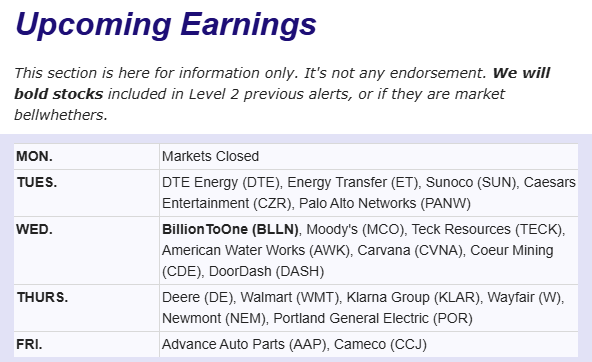
Earnings will be broad-based, with key reports from Walmart, Airbus, Newmont, BHP, Palo Alto Networks, Booking Holdings, Analog Devices, Warner Bros, and Air Liquide, keeping volatility elevated across sectors.


Introducing the LevelFields Portfolio Tracker
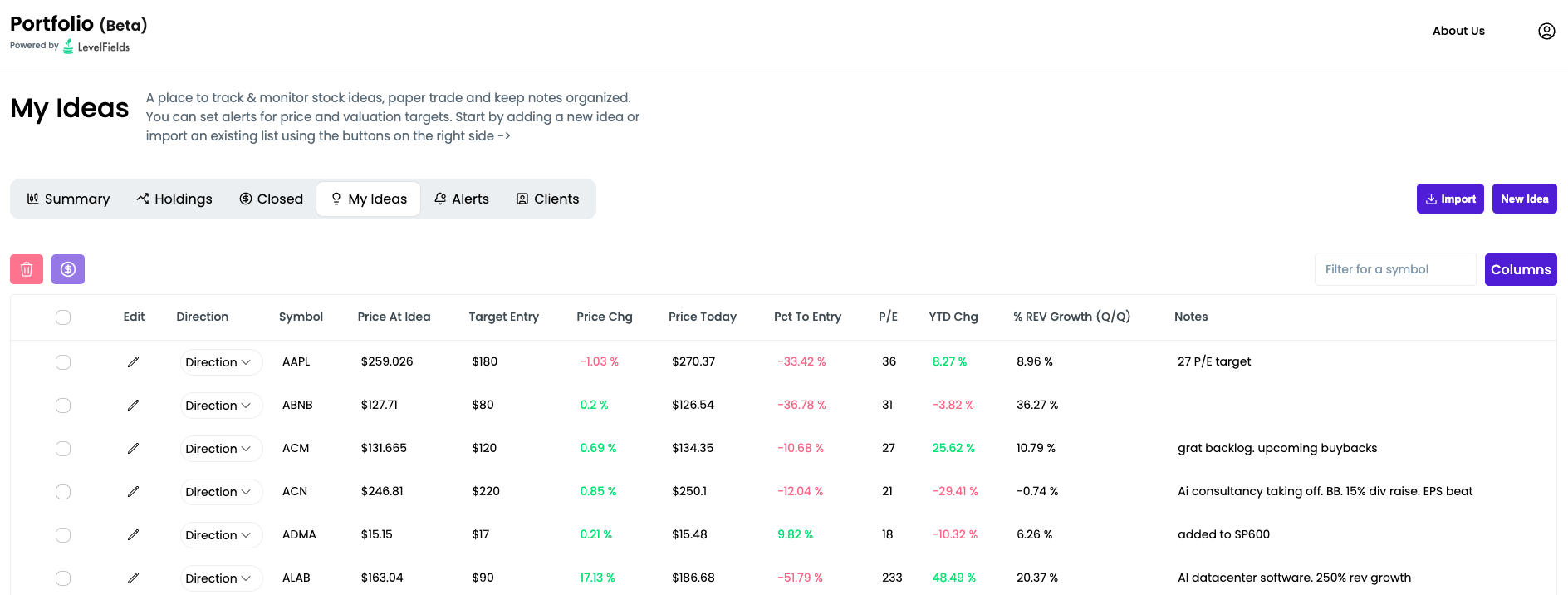
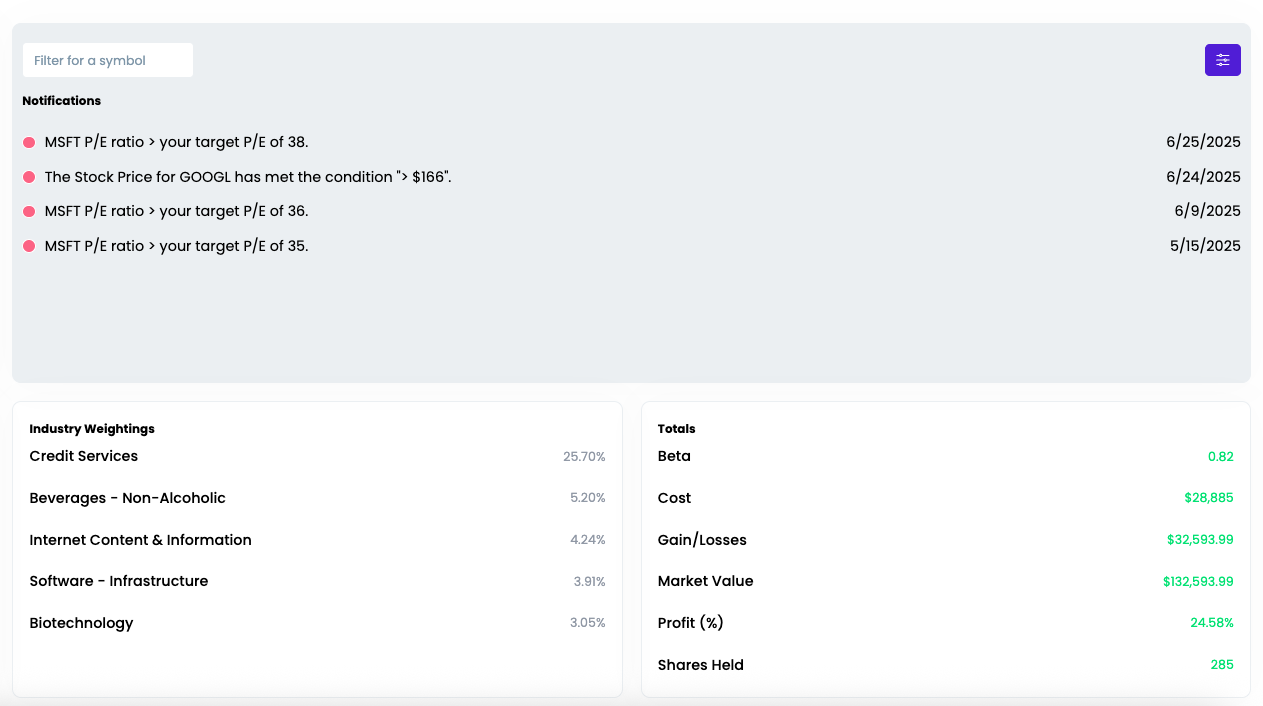
We’ve just launched the new LevelFields Portfolio platform — a centralized dashboard built for active investors and wealth managers to track their trades, organize trade ideas, and monitor real or prospective portfolios.
We've replaced Excel and Google Sheets trade tracking with software that updates as prices and valuations of stocks change, so you don't lose money by missing great entry and exit points.
You can sign up for free!
What it does:
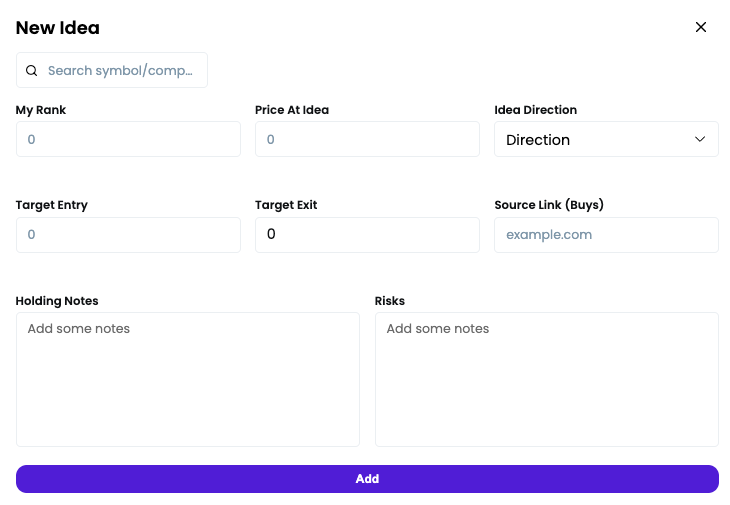
- Lets you add both real positions and idea-stage trades into one unified portfolio.
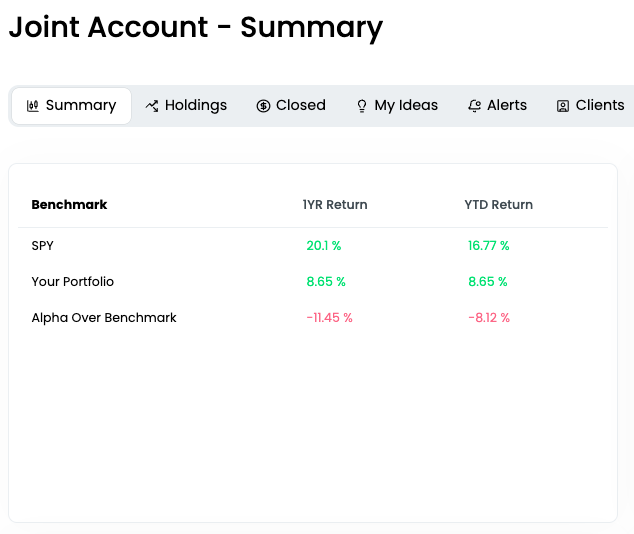
- Tracks allocation, profit/loss, KPIs, P/E, price targets, and thesis notes in one place.
- Allows you to set real-time alerts on valuation changes, price moves, and price targets using bulk editing (e.g. one alert for all holdings).
- Lets you toggle any ticker between “Idea → Holding → Closed” while preserving the original trade thesis and exit notes.
- Designed for traders, advisors, and fund managers who need a live, organized view of positions + rationale, not just a static spreadsheet of tickers.
- Import CSV file of existing ideas, notes, and portfolio holdings for a quick start
- Keep track of reasons you bought and sold to analyze your performance and for compliance
- Design your own model portfolios based on allocations, sector, and industry

Company News
LevelFields AI Stock Alerts Last Week
Cognex (CGNX) +36% — Expanded Share Repurchase Authorization
Cognex surged 36% in a single session after its Board approved a $500 million increase to its existing share repurchase authorization on February 11, 2026. The move signaled strong confidence in the company’s balance sheet and long-term outlook, while meaningfully increasing potential share reduction.
Classover (KIDZ) +20% — New $2 Million Buyback Program
Classover jumped 20% in one day after announcing a $2 million share repurchase program. The authorization reinforced management’s confidence in valuation and capital allocation discipline, supporting near-term investor sentiment.
.png)
How to use LevelFields for Options Trading
Tracking Stocks Without Spreadsheets
The Truth About Dividend Stocks
What's LevelFields' Premium Membership Provide?
This is not financial advice. All information represent opinions only for informational purposes. Given the vast number of stocks we cover in these reports, assume staff covering stocks have positions in stocks discussed.
Have feedback or a request for specific data? Drop us a note at support@levelfields.ai