


.png)

L2 Weekly Stock Market News Analysis
June 14th, 2026

TLDR:
Markets finally got the headline they had been waiting for. The United States and Iran reached a framework agreement to reopen the Strait of Hormuz, triggering a sharp decline in oil prices and a relief rally across global markets. WTI crude plunged more than 5% toward $80 per barrel as investors rushed to unwind fears of a prolonged energy shock and escalating inflation.
The timing could hardly be more important. Just days before the agreement, U.S. inflation accelerated to 4.2%, the highest level in more than three years, while America's personal savings rate fell to just 2.5% as households continued struggling with rising costs. The peace deal offers a potential path toward lower fuel prices and reduced inflation pressure, but affordability remains one of the biggest challenges facing consumers and policymakers alike.
At the same time, investor enthusiasm for growth remains remarkably strong. SpaceX completed the largest IPO in history, finishing its first day with a market capitalization above $2 trillion after surging 19%. The successful debut reinforced investor appetite for AI, space, and next-generation technology companies even as inflation concerns continue to build beneath the surface.
Meanwhile, a new investment theme is beginning to emerge beyond AI itself: photonics. As AI data centers and quantum computing systems grow larger, moving information efficiently is becoming just as important as computing power. Companies involved in optical networking, photonic components, and the materials that make them possible could become some of the next beneficiaries of the broader AI infrastructure buildout.
Looking ahead, investors will closely watch the Federal Reserve's first meeting under Chair Kevin Warsh, developments surrounding the Iran agreement, and a packed week of global economic data as markets debate whether falling oil prices can offset rising inflation and slowing consumer finances.
Markets Finally Get the Headline They Wanted
After nearly four months of war, markets finally received the headline they had been waiting for.
The United States and Iran announced a framework agreement to reopen the Strait of Hormuz, the world's most important oil shipping route and one of the biggest sources of economic uncertainty this year. Investors immediately rushed to unwind the geopolitical fear trade.
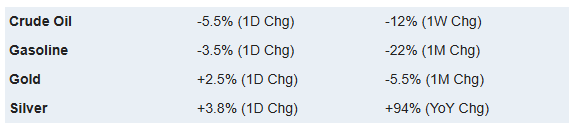
Brent crude fell more than 4% while U.S. crude dropped roughly 5% toward $80 per barrel. S&P 500 futures climbed 1%, Asian equities surged, Treasury yields declined, and Bitcoin rallied as traders bet the agreement could remove one of the largest threats facing the global economy.
Throughout the conflict, investors worried that disruptions to Middle Eastern energy supplies would keep inflation elevated, pressure consumers, and potentially force central banks to maintain restrictive monetary policy for longer than expected. A reopening of Hormuz offers a path toward lower fuel costs, lower transportation costs, and reduced inflationary pressure throughout the global economy.
The deal also arrives at a critical moment for markets. The AI-driven rally has pushed major indices back toward record highs, valuations have become increasingly stretched, and investors have spent weeks debating whether inflation would force policymakers to become more aggressive again.
For now, markets are betting that lower oil prices will help ease those concerns.
The question is whether relief at the gas pump arrives quickly enough to offset the affordability pressures that have been building across the economy for months.

The Economy Needed a Break
The timing of the Iran agreement could hardly be better.
Just days before the deal was announced, inflation accelerated again. Consumer prices rose 0.5% in May, pushing headline CPI to 4.2% year-over-year, the highest level in more than three years. Producer prices climbed 6.5%, suggesting cost pressures remain firmly embedded throughout the economy.

For many Americans, the issue is no longer inflation itself. It is affordability.
Energy prices have surged more than 23%over the past year while gasoline prices are up more than 40%. Housing, insurance, transportation, and food costs continue consuming a larger share of household budgets, leaving less room for savings and discretionary spending.
The strain is beginning to show.
America's personal savings rate has fallen from roughly 4.3% at the start of the year to just 2.5%, approaching levels last seen before the pandemic. Many households are increasingly drawing down reserves simply to maintain their standard of living as wages struggle to keep pace with rising costs.
This growing disconnect helps explain one of the most important themes in today's economy.
Wall Street continues benefiting from record AI investment, booming equity markets, and one of the strongest technology rallies in recent memory. Main Street is dealing with higher living costs, shrinking savings, and increasing financial pressure.

Inflation Is Becoming the Defining Political Issue
The economic pressures facing households are increasingly showing up in public opinion.
According to The Economist's approval tracker, President Trump's overall net approval rating has fallen to -25, the lowest level of his presidency. While the Iran conflict has weighed on sentiment, polling suggests that inflation and affordability remain the administration's biggest challenge.
Trump's net approval rating on inflation and prices has fallen to -43, by far the weakest rating of any major issue. His approval on jobs and the economy sits at -25, while ratings on foreign policy have also deteriorated since the conflict began.

For most Americans, inflation remains the most important issue facing the country. Roughly one-third of voters identify inflation and prices as their top concern, making it the single most important issue across both political parties. Meanwhile, three-quarters of Americans describe economic conditions as either "fair" or "poor," and a majority believe conditions are continuing to worsen.

The challenge for policymakers is that voters rarely separate inflation from the broader economy.
While financial markets spent much of the spring focused on war, oil prices, and the AI boom, many households remained focused on grocery bills, gasoline prices, insurance costs, and housing expenses. The recent decline in the personal savings rate suggests that many consumers are increasingly relying on existing savings to absorb those higher costs.
That is why the market reaction to the Iran deal matters beyond geopolitics.
If lower oil prices translate into lower inflation and improved consumer sentiment, the agreement could provide meaningful economic relief. If inflation remains elevated despite falling energy prices, however, affordability is likely to remain one of the dominant economic and political issues heading into the second half of the year.
For investors, the takeaway is simple: the Iran deal may have reduced one source of uncertainty, but the bigger battle remains the same one markets have been fighting all year — whether inflation can finally be brought under control without causing broader economic damage.
Last's Weeks Sector Winners & Losers
Sector leadership flipped sharply this week as investors moved away from many of the market's highest-flying growth and AI names following the technology-led selloff.
Consumer Staples (XLP +3.94%) emerged as the strongest-performing sector, followed by Health Care (XLV +1.32%), Real Estate (XLRE +1.17%), Financials (XLF +0.82%), and Utilities (XLU +0.25%). The leadership shift reflects investors seeking stability as inflation concerns resurfaced, Treasury yields remained elevated, and uncertainty increased ahead of the Federal Reserve's first meeting under Chair Kevin Warsh.
At the other end of the spectrum, Information Technology (XLK -5.16%) was by far the weakest sector as investors took profits in many of the market's largest AI and semiconductor winners. Energy (XLE -2.77%) also struggled as reports of a U.S.-Iran peace agreement and the planned reopening of the Strait of Hormuz triggered a sharp decline in oil prices, removing much of the geopolitical premium that had supported crude during the conflict.
Communication Services (XLC -0.88%), Consumer Discretionary (XLY -0.82%), Materials (XLB -0.77%), and Industrials (XLI -0.57%) also finished lower as the market rotated toward defensive sectors and away from areas most tied to economic growth and risk appetite.
The result was one of the clearest defensive rotations of the year. While AI, semiconductors, and technology remain the market's dominant long-term themes, last week's performance suggests investors are becoming increasingly sensitive to valuation, inflation risks, and the possibility that higher interest rates may remain in place longer than previously expected.

Upcoming Events This Week
The week ahead will be dominated by two themes: the U.S.-Iran peace agreement and the Federal Reserve's first meeting under Chair Kevin Warsh.
Markets will be watching whether the reopening of the Strait of Hormuz leads to a sustained decline in oil prices after crude plunged following news of the deal.
Investors are increasingly betting that lower energy prices could ease inflation pressures and reduce the risk of further policy tightening.
The Federal Reserve is widely expected to leave rates unchanged on Wednesday, but attention will focus on Warsh's first press conference and whether policymakers signal openness to a rate hike later this year after inflation accelerated to 4.2%.
It will also be a busy week for global central banks, with policy decisions expected from the Bank of England, Bank of Japan, Reserve Bank of Australia, Swiss National Bank, Norges Bank, Riksbank, and Brazil's central bank.
On the economic front, investors will watch U.S. retail sales, industrial production, housing data, and trade figures. China will release industrial production, retail sales, unemployment, and housing data, while the U.K. reports inflation, labor market, and retail sales figures. Japan's inflation report and Germany's business sentiment surveys will provide additional clues about the health of the global economy.

Company News
LevelFields AI Stock Alerts Last Week
Propanc Biopharma (PPCB) +80.0% — Buyback Signals Management Believes Shares Are Deeply Undervalued
Propanc Biopharma surged nearly 80% after announcing a $5 million share repurchase program, a significant authorization relative to the company's roughly $50 million market capitalization. Management stated it believes the stock is significantly undervalued as its lead cancer therapy candidate, PRP, advances toward a pivotal Phase 1b clinical trial.
The company also highlighted recent scientific progress, patent filings, strategic partnerships, and FDA Orphan Drug Designation for pancreatic cancer. While PPCB remains a highly speculative biotech, the size of the buyback sends a strong signal that management believes the market is materially undervaluing the company's future potential.
The Photonics Trade: Betting on the Infrastructure Every Winner Needs
One of the biggest challenges in investing is figuring out which technology will win.
Will it be Nvidia's AI clusters? Quantum computers from IonQ? Xanadu's photonic systems? IBM's superconducting approach? Something else entirely?
The photonics thesis starts from a different question.
What if it doesn't matter?
Whether the future belongs to AI, quantum computing, cloud infrastructure, or some combination of all three, every system eventually runs into the same bottleneck: moving massive amounts of information between chips, servers, racks, and data centers.
Historically, that information traveled through copper wires.
Increasingly, it travels through light.
The reason is simple. Light can move vastly more data while consuming less power and generating less heat. As computing systems become larger and more complex, traditional electrical connections become less efficient. Eventually, every platform is pushed toward optical networking.
This is already happening in AI.
Modern AI clusters contain tens of thousands of GPUs that must constantly communicate with one another. Nvidia's future AI systems will require enormous amounts of optical networking just to move data between racks and servers fast enough to keep the GPUs productive.
But the same trend is emerging in quantum computing.
Despite headlines focusing on competing quantum approaches—superconducting, trapped ion, neutral atom, and photonic—every architecture eventually faces the same scaling problem. You can only fit so many qubits into a single system before you need to connect multiple systems together. Once that happens, the connection increasingly becomes optical.
That helps explain why IonQ has spent the past year acquiring optical networking, photonics, detector, and quantum communications companies. The company is effectively betting that regardless of which quantum architecture wins, optical interconnects become essential infrastructure.
For investors, that creates a compelling opportunity.
Rather than trying to predict which AI model wins, which quantum architecture dominates, or which hyperscaler spends the most, investors can focus on the infrastructure layer that all of them require.
The supply chain looks roughly like this:
Raw Materials → Lasers & Photonic Components → Optical Networking → AI & Quantum Systems
At the very beginning of that chain sits germanium, a specialty material used in photodetectors and optical receivers that convert light signals back into usable data. One of the more overlooked ways to gain exposure is through Teck Resources (TECK), which is one of the largest Western producers of germanium through its zinc refining operations.
Most of the investment opportunity, however, lies further down the value chain.
Coherent (COHR) manufactures lasers, optical transceivers, and photonic components that help move information through AI data centers and networking equipment. As optical networking adoption increases, Coherent sits directly in the middle of the buildout.
Lumentum (LITE) supplies many of the optical components used throughout telecom infrastructure, cloud networks, and AI data centers. It is one of the purest public plays on the growth of fiber optics and optical interconnects.
Marvell (MRVL) develops the networking chips that sit between AI processors and optical networks. As AI clusters become larger, Marvell's networking silicon becomes increasingly important for moving data efficiently between GPUs.
GlobalFoundries (GFS) and Tower Semiconductor (TSEM) provide exposure to the manufacturing side of the story. Both companies have capabilities in silicon photonics and specialty semiconductor production, making them potential beneficiaries as demand for photonic chips grows.
IonQ (IONQ) represents a different angle. The company has spent the past year acquiring optical networking, detector, and quantum communications businesses, signaling management's belief that optical interconnects will become a critical layer of future quantum systems regardless of which architecture ultimately wins.
Xanadu (XNDU) may be the purest photonics story of them all. Unlike most computing companies that use light primarily to move information, Xanadu uses photons themselves as the computing medium. The company became the world's first publicly traded pure-play photonic quantum computing company earlier this year and is pursuing a fundamentally different approach than competitors such as IBM, Google, IonQ, Rigetti, and D-Wave.
What makes Xanadu particularly interesting is the progress it has demonstrated. Over the past several years, the company has published three major papers in Nature showing advances in photonic quantum computing, including a programmable photonic processor, a modular quantum computer built from interconnected photonic chips, and the creation of fault-tolerant photonic qubits on an integrated chip. While the technology remains early and significant engineering hurdles remain, the research increasingly suggests that large-scale photonic quantum computing is technically achievable.
Beyond hardware, Xanadu also developed PennyLane, one of the leading open-source quantum software platforms that works across multiple quantum architectures. That gives the company exposure not only to photonic quantum hardware, but also to the broader quantum software ecosystem.
For investors, Xanadu represents one of the highest-risk but highest-upside ways to invest in the photonics theme. If the future of computing increasingly relies on photons for both communication and computation, XNDU sits at the intersection of both trends.
Together, these companies represent different ways to invest in the same trend.
The first phase of the AI boom was about computing power.
The next phase may increasingly be about communication.
Because ultimately, it doesn't matter how powerful a chip becomes if it cannot efficiently communicate with everything around it. Whether the future belongs to AI, quantum computing, or something we haven't imagined yet, the systems still need a way to move information—and increasingly, that way is light.
.png)
How to use LevelFields for Options Trading
Tracking Stocks Without Spreadsheets
The Truth About Dividend Stocks
What's LevelFields' Premium Membership Provide?
This is not financial advice. All information represent opinions only for informational purposes. Given the vast number of stocks we cover in these reports, assume staff covering stocks have positions in stocks discussed.
Have feedback or a request for specific data? Drop us a note at support@levelfields.ai