


.png)
L2 Weekly Stock Market News Analysis
June 21st, 2026

TLDR:
The AI trade continues to dominate markets, but it may now be influencing far more than just stock prices. AI-related companies account for roughly 39% of the S&P 500, technology funds are seeing record inflows, and hyperscalers are issuing hundreds of billions of dollars in debt to fund data centers, power infrastructure, and next-generation computing systems. Increasingly, AI is helping drive corporate borrowing, economic growth, consumer confidence, and financial markets themselves.
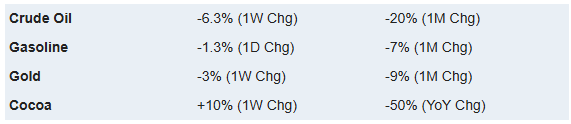
That enthusiasm remained on full display last week. Industrials (+5.86%), Technology (+5.19%), and Materials (+4.88%) led the market higher as investors continued pouring capital into AI infrastructure, power demand, and data-center construction. Meanwhile, Energy (-6.15%) lagged as oil prices continued falling following the reopening of the Strait of Hormuz, while traditional defensive sectors such as Real Estate, Consumer Staples, and Health Care underperformed.
At the same time, signs of concentration and speculative behavior continue to emerge. A small number of AI-linked companies are driving a disproportionate share of market gains, technology funds are seeing record inflows, and investors continue rewarding nearly anything connected to the AI buildout. The challenge is that the larger AI becomes, the more dependent the broader economy becomes on its continued success.
Looking ahead, investors will closely watch the Fed's preferred inflation gauge, the PCE Price Index, along with personal income and spending data, durable goods orders, PMI surveys, GDP revisions, and the University of Michigan consumer sentiment report. Markets will also monitor the Federal Reserve's annual bank stress test results and continue watching oil prices following the reopening of the Strait of Hormuz.
The biggest risk facing AI investors is not that the technology fails. It is that financing conditions tighten, infrastructure bottlenecks emerge, or economic growth slows before today's expectations can be fully realized.
The question is no longer whether AI will reshape the economy.
The question is whether today's valuations already assume a future in which everything goes right.
The AI Trade Has Become The Economy
For most of the past two years, investors have viewed AI primarily as a stock market story.
That perspective may now be outdated.
AI is no longer just driving semiconductor stocks, cloud providers, and software companies. Increasingly, it is driving credit creation, corporate borrowing, consumer confidence, and economic growth itself.
According to UBS, the United States now accounts for more than half of the global credit impulse, largely due to borrowing associated with AI infrastructure spending. Hyperscalers including Microsoft, Amazon, Meta, Google, and others are collectively expected to issue hundreds of billions of dollars in debt to fund the construction of data centers, power infrastructure, networking equipment, and next-generation computing systems.
The scale of spending is unprecedented. In many ways, AI has become thelargest industrial buildout since the internet itself.
The impact extends beyond corporate America.
Consumer spending has remained surprisingly resilient despite inflation running above 4% and personal savings rates falling to roughly 2.5%, levels not seen since before the pandemic. Much of that resilience has been supported by rising asset prices. Household wealth has surged alongside the stock market, helping consumers continue spending even as real income growth remains under pressure.


The result is a powerful feedback loop. AI spending drives economic growth. Economic growth supports markets. Rising markets support consumer confidence and spending. That spending helps sustain growth.
The challenge is that the larger AI becomes, the more dependent the broader economy becomes on its continued success.
For investors, that is both the opportunity and the risk.

The Great Concentration
One of the defining characteristics of every major market bubble is concentration.
The railroad boom concentrated capital into railroads. The Nifty Fifty concentrated capital into a handful of blue-chip growth companies. The dot-com bubble concentrated capital into internet stocks.
Today's concentration revolves around artificial intelligence.
According to Bank of America, AI-related companies now account for approximately 39% of the S&P 500, placing concentration levels near historical extremes. At the same time, investors continue pouring money into the trade at a record pace.
U.S. equities recently experienced the largest weekly inflow on record. Technology funds also saw record inflows as investors continued chasing exposure to AI infrastructure, semiconductors, and hyperscale computing.
Meanwhile, market leadership has become increasingly narrow. A small number of AI-linked companies continue driving a disproportionate share of overall market returns. While this concentration has helped fuel one of the strongest rallies in years, it also means investors are becoming increasingly dependent on a shrinking number of companies to justify current valuations.
The result is that investor positioning has become increasingly crowded. Capital continues flowing into many of the same AI-related names, creating a situation where expectations are rising just as quickly as stock prices.
One example is Sandisk, which recently recorded a monthly RSI above 99—an extraordinarily rare reading and one of the most overbought levels ever recorded for a publicly traded stock.

None of this means the AI thesis is wrong.
In fact, history suggests the largest bubbles are often built around the most transformative technologies. Railroads changed the world. The internet changed the world. AI may ultimately prove even more impactful.
The danger is not that the technology fails.
The danger is that expectations become detached from reality.

Is Warsh The First Real Threat To The AI Rally?
For years, investors have operated under a relatively simple assumption: whenever economic conditions deteriorated or markets experienced significant stress, the Federal Reserve would eventually intervene.
That assumption became known as the "Fed Put."
Under successive Fed chairs, investors grew accustomed to lower rates, liquidity injections, quantitative easing, and increasingly transparent guidance designed to support financial conditions and stabilize markets.
Kevin Warsh's first meeting as Fed Chair may have challenged that framework.
The Fed left rates unchanged, but the messaging surrounding the meeting was notably different from what investors had grown accustomed to. Warsh removed forward guidance, declined to provide his own dot-plot projections, emphasized inflation risks, and repeatedly stressed the importance of restoring credibility on price stability.
Markets quickly adjusted. Rate-cut expectations moved lower, while the probability of future rate hikes increased. Prediction markets and interest-rate swaps are increasingly pricing a scenario where rates remain elevated well into 2027.
If inflation remains stubbornly high, that creates a potentially uncomfortable backdrop for many AI-related assets.
Much of today's enthusiasm is built on future cash flows, future growth, and future profitability. Higher interest rates reduce the present value of those future earnings and increase the cost of financing massive AI infrastructure projects.
Warsh may ultimately prove no different from previous Fed chairs once economic pressure intensifies. Markets have heard tough talk before.
But for the first time in years, investors are being forced to consider the possibility that the Fed may prioritize inflation over asset prices.
If that happens, the rules that powered much of the AI rally could begin to change.

What Could Actually Burst The Bubble?
The biggest risk facing AI investors is not that artificial intelligence fails.
The technology is already delivering measurable productivity gains, transforming industries, and attracting unprecedented corporate investment.
History suggests bubbles rarely burst because the underlying innovation proves worthless.
They burst because financing conditions change.
Today, several factors could challenge the AI narrative.
Higher interest rates would increase financing costs across the entire ecosystem, from hyperscale data centers to startup funding rounds.
Credit tightening could slow the flow of capital supporting infrastructure expansion and speculative investment.
A meaningful slowdown in AI capital expenditures would likely force investors to reassess some of the aggressive growth assumptions currently embedded in valuations.
Consumer weakness represents another underappreciated risk. With savings rates near historic lows and spending increasingly supported by rising asset prices, any significant market correction could create a negative feedback loop between wealth, confidence, and consumption.
Political pressure is also beginning to build. Concerns surrounding AI-driven job displacement, energy consumption, water usage, data-center expansion, and market concentration are attracting increasing attention from policymakers and local communities.
The AI buildout is also increasingly running into a simple problem: the physical world moves slower than investors would like. Data centers require transformers, electrical equipment, power connections, and massive amounts of supporting infrastructure, much of which now has wait times measured in years rather than months. As technology companies, utilities, and manufacturers all race to expand capacity, they are competing for the same limited equipment. In some cases, prices for critical components have nearly doubled since 2019 while demand has surged several-fold. Even if AI demand remains strong, building the infrastructure needed to support that demand may take far longer than the market currently expects.

In other words, the challenge may not be finding enough money to build AI infrastructure. It may be finding enough power, equipment, and physical capacity to support it.
None of these risks necessarily end the AI boom.
But they could end the assumption that growth will continue indefinitely without obstacles.
That may be the most important distinction investors should keep in mind.
The question is no longer whether AI will reshape the economy.
The question is whether today's valuations already assume a future in which everything goes right.
Last's Weeks Sector Winners & Losers
Growth and AI-linked sectors retook leadership this week as investors continued pouring money into technology and infrastructure plays despite growing concerns about valuations and future Fed policy.
Industrials (XLI +5.86%), Information Technology (XLK +5.19%), and Materials (XLB +4.88%) led the market higher, reflecting continued enthusiasm for AI infrastructure, data-center construction, and power demand. Financials (XLF +3.48%) also gained as investors increasingly priced in a higher-for-longer rate environment.
At the other end of the spectrum, Energy (XLE -6.15%) was the week's weakest sector as oil prices continued falling following the reopening of the Strait of Hormuz. Defensive sectors also lagged, with Real Estate (XLRE -2.27%), Consumer Staples (XLP -2.12%), Communication Services (XLC -1.63%), and Health Care (XLV -1.40%) all finishing lower.
The result was a sharp reversal from the prior week's defensive rotation, with investors once again favoring the sectors most directly tied to AI, infrastructure spending, and economic growth.

Upcoming Events This Week
The week ahead will be dominated by inflation data and signs of whether economic growth remains strong enough to support the massive wave of AI-driven investment powering markets.
Investors will closely watch the Fed's preferred inflation gauge, the PCE Price Index, after policymakers recently raised their inflation forecasts and signaled a more hawkish outlook. Personal income and spending data will also provide insight into consumer health as savings rates remain near multi-year lows.
Markets will receive additional updates through durable goods orders, S&P Global PMI surveys, new home sales, GDP revisions, and the University of Michigan consumer sentiment report. Investors will also watch the Federal Reserve's annual bank stress test results for clues about the health of the financial system.
Globally, PMI data from Europe, Asia, and the U.K. will offer a broader view of economic activity, while Canada releases inflation data and Mexico announces its latest interest-rate decision.
Finally, traders will continue monitoring oil markets following the reopening of the Strait of Hormuz as they assess whether lower energy prices can help ease inflation pressures in the months ahead.

Company News
LevelFields AI Stock Alerts Last Week
Smartbird (BIRD) +40.0% — CEO Hired
Shares of Smartbird (formerly Allbirds) surged roughly 40% after the company officially completed one of the more dramatic corporate pivots of the AI era. The former footwear maker announced it had changed its name to Smartbird, appointed AI infrastructure executive Nadia Carlsten as CEO, and expanded its financing facility from $50 million to $100 million to support its new strategy of providing AI infrastructure and computing capacity as a service.
Carlsten previously led Denmark's national AI supercomputing initiative and brings experience from Amazon Web Services, SandboxAQ, and the broader AI ecosystem. Management says the company is already in discussions with prospective customers and is designing its first AI cluster deployments.
The move highlights the extraordinary investor enthusiasm surrounding anything tied to artificial intelligence. Just months ago, the company was known primarily for selling wool sneakers. Today, investors are valuing it as a potential participant in the AI infrastructure buildout despite having no meaningful AI revenue and only recently exiting its legacy footwear business.
While Smartbird remains highly speculative, the rally serves as another reminder of how powerful the AI theme has become. Throughout market history, some of the strongest speculative periods have occurred when struggling companies successfully reinvent themselves around the market's hottest trend. Whether Smartbird ultimately becomes a meaningful AI infrastructure provider remains to be seen, but the stock's reaction demonstrates how eager investors remain to find the next AI winner.
.png)
How to use LevelFields for Options Trading
Tracking Stocks Without Spreadsheets
The Truth About Dividend Stocks
What's LevelFields' Premium Membership Provide?
This is not financial advice. All information represent opinions only for informational purposes. Given the vast number of stocks we cover in these reports, assume staff covering stocks have positions in stocks discussed.
Have feedback or a request for specific data? Drop us a note at support@levelfields.ai