


.png)
L2 Weekly Stock Market News Analysis
July 26th, 2026
TLDR:
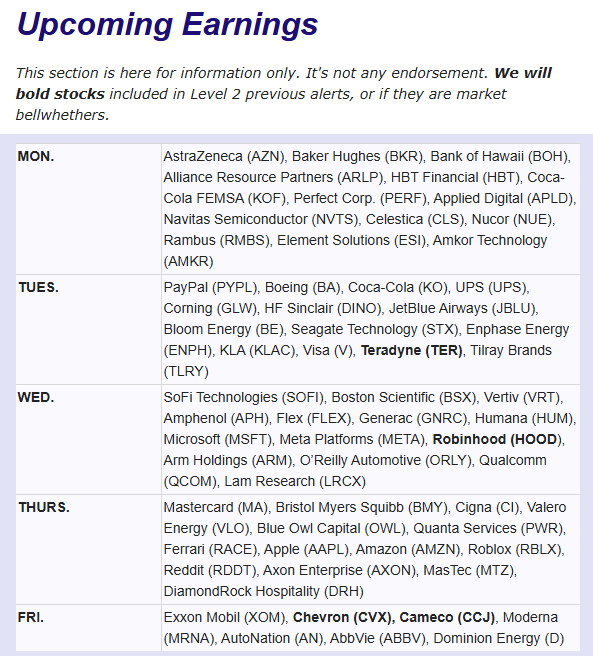
The biggest story this week is whether Big Tech can prove that record AI spending is translating into stronger growth and profits. Microsoft (MSFT) and Meta (META) report Wednesday, followed by Apple (AAPL) and Amazon (AMZN) on Thursday, while SK Hynix reports Tuesday. Together, the results will provide a broad read on cloud demand, digital advertising, consumer devices, memory chips, and the cost of building AI infrastructure.
The reports arrive as investors become more selective about the AI trade. Microsoft will need to show that Azure and Copilot growth can justify another major increase in capital spending. Meta must prove its AI investments are strengthening advertising and margins. Amazon will be judged on whether accelerating AWS growth is offsetting heavy infrastructure costs, while Apple’s more capital-light strategy offers a direct contrast to its peers.
The Federal Reserve’s Wednesday rate decision adds another layer of risk, especially with markets increasingly concerned about higher long-term yields and the cost of financing the AI buildout. Oil will also remain important after briefly climbing above $100 before retreating as the United States paused strikes against Iran and diplomatic activity continued.
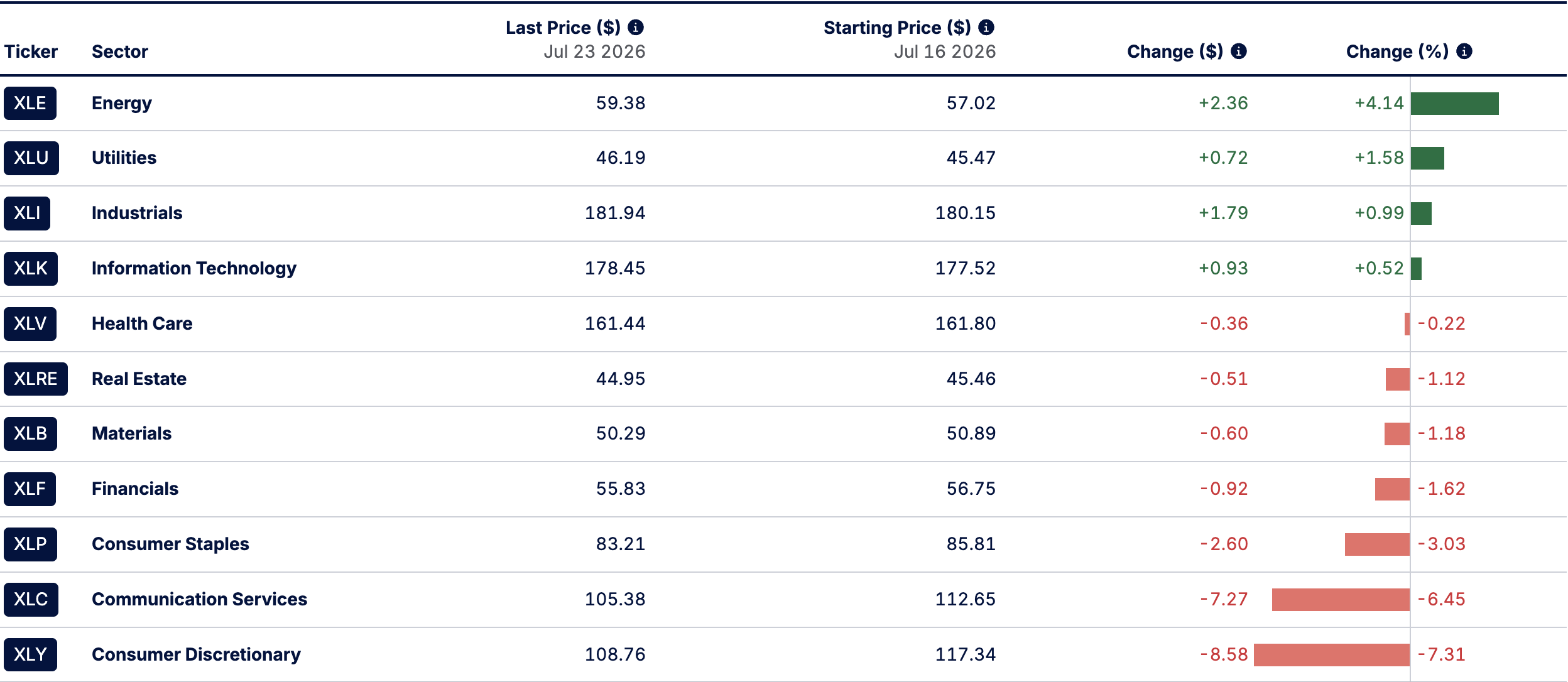
Last week’s sector performance showed a highly selective market. Energy (XLE +4.14%) led, followed by Utilities (XLU +1.58%), Industrials (XLI +0.99%), and Technology (XLK +0.52%). Consumer Discretionary (XLY -7.31%) and Communication Services (XLC -6.45%) suffered the largest losses, while Consumer Staples (XLP -3.03%), Financials (XLF -1.62%), Materials (XLB -1.18%), and Real Estate (XLRE -1.12%) also declined.
Iran Paused The Strikes—But Not The Energy Risk
The latest development in the Iran conflict is more hopeful than what markets were facing a week ago. The United States paused its bombing campaign as Omani officials arrived in Tehran for negotiations aimed at reopening the Strait of Hormuz. Reports suggest progress has been made, creating a possible diplomatic off-ramp after nearly two weeks of escalating attacks.
But a pause in strikes is not the same as a return to normal.
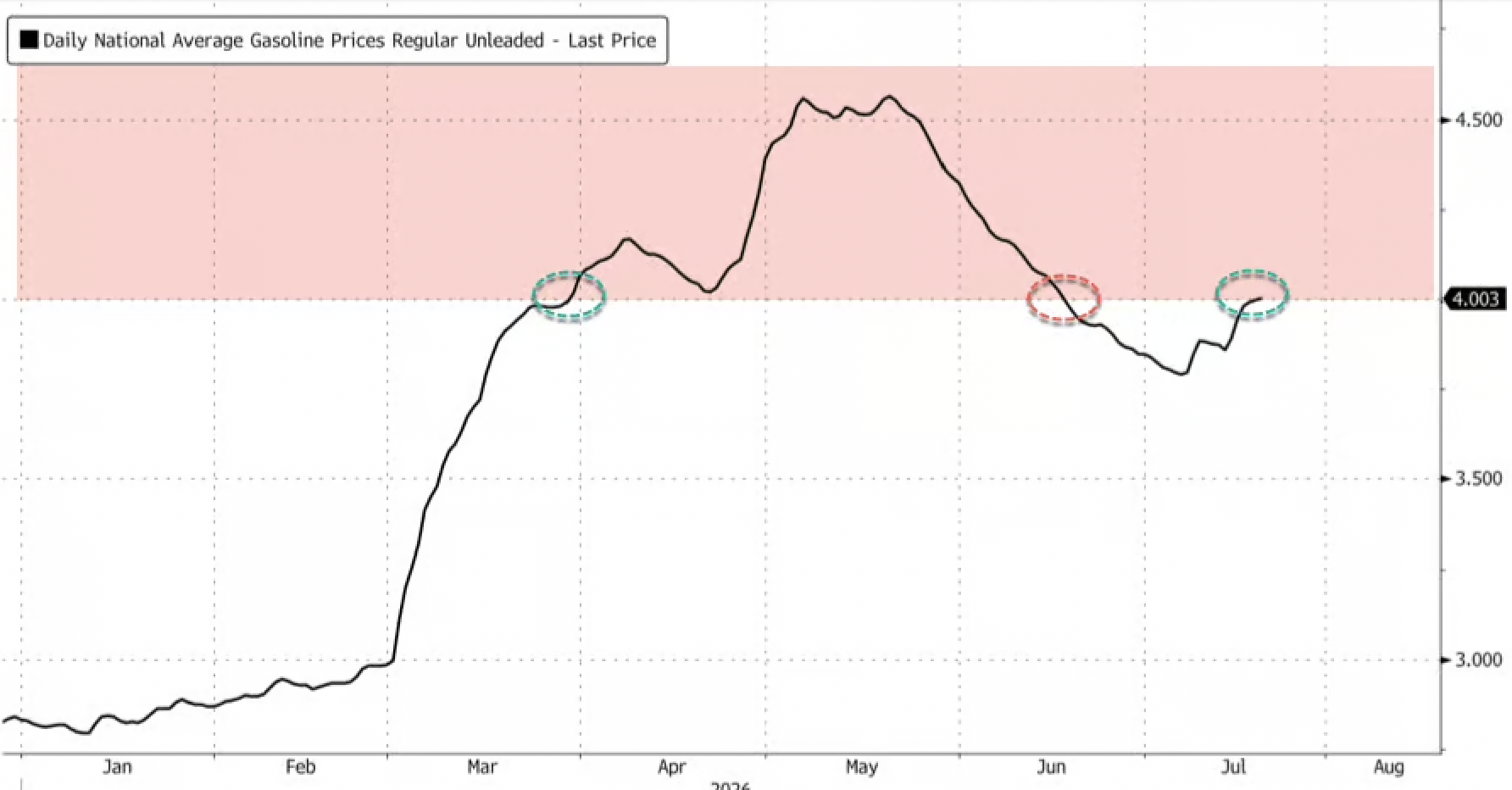
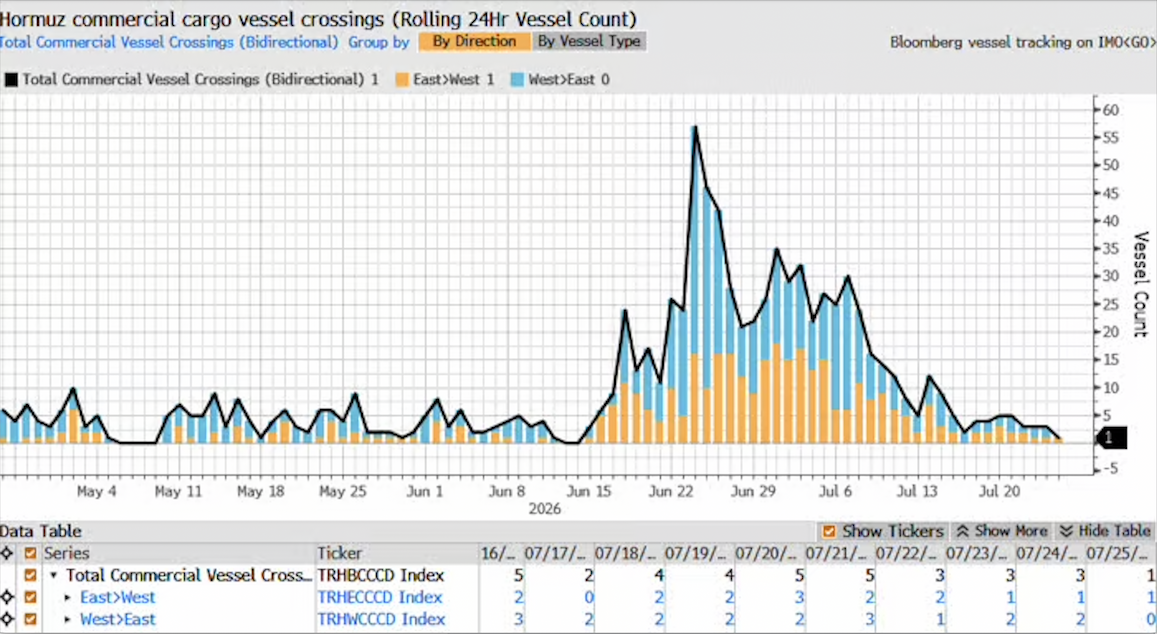
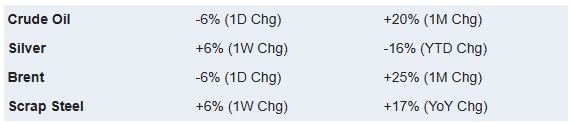
Traffic through Hormuz remains severely restricted, while the conflict has also begun threatening the Red Sea route that Gulf producers were using to avoid the Strait. Houthi attacks on Saudi-linked tankers and infrastructure mean the region’s two most important shipping corridors are now exposed at the same time. Brent briefly crossed $100 before falling back on diplomatic optimism, but it still ended the week near $97 after gaining roughly 27% in two weeks.
The larger issue is that much of the world has already used the buffers that softened the first disruption. Governments released oil reserves, China sharply reduced imports, and countries rerouted shipments wherever possible. Those actions prevented an even larger price spike, but they also leave less protection if negotiations fail and supply is disrupted again.
For investors, this has become a two-sided trade. A credible agreement that restores tanker traffic could cause oil and energy stocks to fall quickly. But if talks break down or attacks resume, Exxon (XOM), Chevron (CVX), and the Energy Select Sector SPDR (XLE) remain some of the cleanest hedges. The better approach is not to chase oil after a vertical move, but to maintain selective energy exposure while watching physical shipping flows—not just diplomatic headlines—for confirmation that the crisis is actually easing.
The Bond Market Is Repricing The AI Buildout
The most important shift in markets may be happening outside the stock market. Long-term Treasury yields are rising sharply, with the 30-year yield near 5.2% and the inflation-adjusted yield near 3%, both at their highest levels in years. That is creating a tougher backdrop for technology stocks even when companies continue reporting strong revenue and earnings.
The reason is simple: higher bond yields reduce the present value of profits expected far into the future. That matters most for AI companies whose valuations depend on years of growth and spending before the full payoff arrives. When safe government bonds offer higher returns, investors become less willing to pay premium multiples for distant earnings. Good results can therefore be met with falling share prices if rates rise faster than expectations improve.
This helps explain why semiconductor and technology stocks have struggled despite generally solid operating results. The market is no longer evaluating earnings in isolation. It is comparing those earnings with a much higher cost of capital and a growing list of competing places to earn a return.
The Federal Reserve is adding another layer of uncertainty. Markets are assigning roughly a38% probability to a July rate increase and have fully priced in one by September, even though most investors recently expected policymakers to remain on hold until after the midterm elections. A hike might help contain inflation expectations and stabilize long-term bonds, but it would also increase the pressure on expensive growth stocks.
Companies with near-term cash flow, durable margins, and less dependence on distant profits should hold up better than businesses whose valuations require everything to go right several years from now. More importantly, rising yields are changing not only how AI stocks are valued, but who will be responsible for financing the next wave of infrastructure.
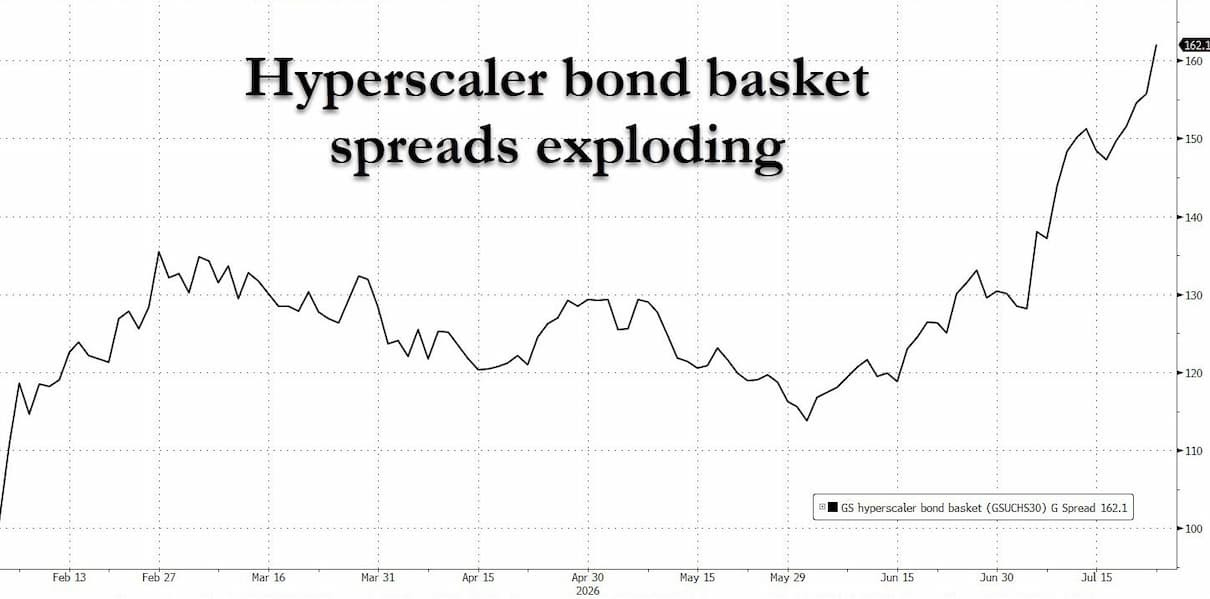
What the chart below shows: The gap between hyperscaler borrowing costs and safer government bonds has widened sharply, reaching its highest level of the year. Investors are demanding much more interest to lend to the largest AI spenders because they see greater risk in their rapidly rising debt and capital spending. This does not mean the companies are close to default, but it does show that the bond market is becoming less comfortable financing the AI buildout at current prices.
AI Suppliers Are Starting To Finance Their Own Demand
The AI buildout is entering a more complicated phase. The question is no longer only whether massive spending will eventually generate acceptable returns. It is whether the companies benefiting from the boom will increasingly need to finance projects that could still be delayed—or blocked entirely—before construction begins.
Nvidia is reportedly discussing a financial backstop of up to $250 billion for OpenAI to lease a massive data-center project in Ohio. In practical terms, the company supplying many of the chips could help guarantee the financing that allows its customer to build the facility and purchase more computing equipment. That could protect Nvidia’s future order pipeline, but it also creates a more circular relationship: the supplier benefits from the demand while helping make that demand financially possible.
The problem is that financing does not guarantee a project will actually get built. In the first quarter of 2026 alone, local opposition reportedly delayed or blocked at least 75 data-center projects worth roughly $130 billion. Concerns over power consumption, water use, noise, utility rates, and taxpayer-funded grid upgrades are turning local approval into another scarce input. Developers may have the chips, capital, and power lined up, yet still lose months—or the entire project—to zoning fights and public resistance.
That makes “permission to operate” increasingly important. A developer can raise more capital, order additional equipment, or move to a different lender. It cannot always accelerate a public hearing, zoning appeal, or political dispute. During those delays, interest continues accruing, equipment costs can change, and land or power reservations remain tied up without producing revenue.
This is happening as AI-related borrowing is already surging. Roughly $489 billion of AI-related debt has reportedly been issued this year, about 50% more than during all of last year, with most of it raised by companies outside the largest hyperscalers. At the same time, borrowing costs have risen, technology bond prices have weakened, and the cost of insuring hyperscaler debt against default has reached record levels.
That combination changes the risk profile of the entire ecosystem. Chip suppliers, AI developers, data-center operators, cloud providers, utilities, private lenders, and local governments are becoming tied to the same projects. Supplier-backed financing can keep construction moving when traditional lenders become more cautious, but it cannot solve every permitting or community problem. If a project is delayed, the customer may postpone equipment orders, the developer may miss lease milestones, and suppliers may discover that the demand they helped finance is arriving later than expected.
The key distinction is no longer simply between strong and weak AI demand. It is between announced capacity and buildable capacity. A project with committed customers, secured power, completed permits, community support, and finalized financing is far more valuable than a large pipeline that still depends on zoning approvals, future leases, or another round of capital.
Nvidia (NVDA) could benefit if its support keeps OpenAI’s expansion moving, but investors should closely examine how much risk Nvidia assumes and whether the underlying project has cleared the nonfinancial obstacles that could delay construction. Microsoft (MSFT) and Amazon (AMZN) remain better-capitalized ways to own the buildout because their spending is supported by established cash-generating businesses.
Vertiv (VRT) and Amphenol (APH) remain attractive because their equipment is generally purchased as funded projects move closer to construction. Bloom Energy (BE) offers greater upside if data centers increasingly secure dedicated on-site power, which can reduce dependence on strained public grids. Applied Digital (APLD) carries more execution risk because its valuation depends heavily on turning proposed capacity into signed, financed, permitted, and operational leases.
Big Tech Earnings Will Separate The Winners
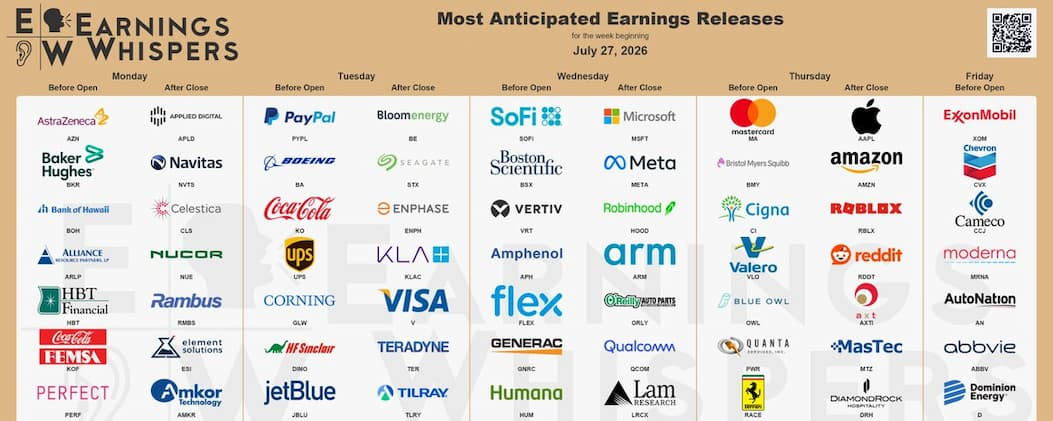
This week brings the clearest test yet of whether the AI buildout is producing results. Microsoft, Meta, Amazon, and Apple all report within roughly 24 hours of one another, but each represents a different part of the trade. The key is not simply whether they beat expectations. It is whether their results prove that AI spending is improving cloud growth, advertising, products, and margins.
Microsoft is the enterprise AI test. Investors should watch Azure growth, Copilot adoption, cloud margins, and the company’s spending outlook. Azure is expected to grow roughly 39%–40%, but annual capital spending is approaching $190 billion and free cash flow has fallen as construction accelerates. If Azure meets or exceeds guidance without another meaningful drop in margins, Microsoft could become one of the cleaner post-earnings buys. If growth slows while spending continues rising, the stock and broader enterprise software group could remain under pressure.
Meta is the monetization test. Meta has raised its planned capital spending to between $125 billion and $145 billion, but unlike Microsoft or Amazon, it does not operate a major cloud platform that can directly sell that capacity to outside customers. The payoff must appear through better advertising, stronger engagement, and higher operating profit. That makes META the highest-risk, highest-reward report: accelerating ad revenue and stable margins could drive a sharp rebound, while another spending increase without corresponding profit growth would be difficult for the market to absorb.
Amazon is the infrastructure-conversion test. AWS growth accelerated to 28% last quarter, its fastest pace in nearly four years, while backlog reached approximately $364 billion. If AWS growth and margins remain strong, investors are more likely to view Amazon’s enormous infrastructure spending as productive investment rather than a drain on cash. That would make AMZN one of the more attractive catch-up trades among the hyperscalers. A slowdown would renew pressure on Amazon and could also weigh on data-center suppliers.
Apple is the defensive technology test. Apple’s report is less dependent on giant AI data centers and more focused on device demand, services, pricing power, and rising memory costs. The stock has benefited as investors moved away from more capital-intensive AI names. If demand remains strong and margins hold despite higher component costs, Apple could continue acting as a relative safe haven within technology. Weak margin guidance would undermine that case.
Supporting reports will provide a clearer read across the rest of the AI supply chain. ARM and Qualcomm (QCOM) will show whether AI demand is expanding beyond data centers into phones, computers, vehicles, and other devices. Vertiv (VRT) and Amphenol (APH) will test whether demand remains strong for the power, cooling, connectors, and electrical systems every new data center requires. Lam Research (LRCX) and KLA (KLAC) will show whether memory and chip manufacturers are still expanding production despite the recent semiconductor selloff.
Bloom Energy (BE) is the higher-risk power trade, with investors focused on the timeline for Oracle’s 2.45-gigawatt Project Jupiter, the company’s manufacturing expansion, and whether rapid revenue growth is translating into stronger margins. Applied Digital (APLD) is even more dependent on execution: its existing CoreWeave lease has begun producing meaningful EBITDA, but the major catalyst remains converting its unsigned 900-megawatt pipeline into firm leases and financing.
The cleaner post-earnings setups are companies that can show durable demand, pricing power, and improving profitability. VRT, APH, LRCX, and KLAC should be favored if guidance confirms continued strength, while BE and APLD require stronger evidence that growth is converting into dependable cash flow.
Last's Weeks Sector Winners & Losers
Sector performance was sharply divided last week. Energy (XLE +4.14%) led the market, followed by Utilities (XLU +1.58%), Industrials (XLI +0.99%), and Information Technology (XLK +0.52%). Health Care (XLV -0.22%) was nearly flat.
The largest losses came from Consumer Discretionary (XLY -7.31%) and Communication Services (XLC -6.45%). Consumer Staples (XLP -3.03%), Financials (XLF -1.62%), Materials (XLB -1.18%), and Real Estate (XLRE -1.12%) also declined.
The split suggests investors favored energy, utilities, and select industrial and technology exposure while cutting positions tied more closely to consumer spending and communication platforms. Rather than a broad market selloff, the week reflected a highly selective rotation with unusually large gaps between the strongest and weakest sectors.
Upcoming Events This Week
The week ahead will be driven by the U.S.-Iran conflict, Big Tech earnings, and the Federal Reserve. Investors will watch for renewed negotiations as continued strikes and shipping disruptions keep pressure on oil prices and inflation.
Apple, Microsoft, Amazon, Meta, and Samsung report earnings, while the Fed sets rates alongside Q2 GDP and inflation data. Overseas, the Bank of England and Bank of Japan meet, Europe reports GDP and inflation, and China releases PMIs following its July Politburo meeting.

Company News
LevelFields AI Top Stock Alert Last Week
RingCentral (RNG) +25.0% (1D) — Dividend Increase and Raised Guidance
Shares of RingCentral surged roughly 25% in one day after the companyincreased its quarterly dividend by approximately 67%, from $0.075 to $0.125 per share, while delivering second-quarter results above the high end of guidance and raising its full-year outlook. Revenue increased 5.9% year over year, non-GAAP EPS rose to $1.22, and free cash flow climbed nearly 25% to $180 million.
The dividend increase was especially notable because it signaled growing confidence in the durability of RingCentral’s cash generation. Management also raised full-year revenue, margin, EPS, and free-cash-flow guidance, with free cash flow now expected to reach $615 million to $625 million. Meanwhile, customers using at least one paid native AI product now represent approximately 13% of annual recurring revenue, double the level from one year ago.
For investors, the move shows how powerful a dividend increase can be when it confirms a broader improvement in fundamentals. RingCentral was not simply returning more cash to shareholders—it was doing so alongside expanding margins, stronger free cash flow, raised guidance, share repurchases, and growing adoption of its AI products.
Tesla’s AI Ambition Is Running Ahead Of Its Profits
Tesla’s second-quarter results captured the central tension in the company’s investment story. Revenue jumped 28% year over year to $28.2 billion, well above expectations, as vehicle deliveries rebounded roughly 25% to more than 480,000 units. But adjusted earnings fell 18% to $0.33 per share, missing expectations of roughly $0.51, as higher research, AI-compute, and infrastructure spending weighed on profitability.
The automotive business improved from last year but weakened sequentially. Automotive gross margin rose to 16.3% from 15% a year ago, yet fell sharply from 19.2% in the first quarter. That suggests stronger vehicle volumes are not yet translating into consistent margin recovery, particularly as global price competition and the cost of new programs remain elevated. Tesla still generates most of its revenue from selling vehicles, making the health of the core auto business critical while its longer-term AI projects scale.
There were meaningful signs of progress beyond cars. Active Full Self-Driving subscriptions reached 1.48 million, up 56% year over year, while Tesla more than doubled its on-site computing capacity in Texas during the first half. The company also said Cybercab entered production, initial Optimus manufacturing lines are being installed, and the Tesla Semi remains on track for volume production. Energy storage provided another bright spot, with deployments rising more than 50% from the first quarter to 13.5 gigawatt-hours as data centers and power-grid constraints increase demand for batteries.
The problem is that Tesla is spending heavily today for revenue streams that may still take years to mature. Capital expenditures reached $5.8 billion during the quarter, bringing first-half spending to roughly $8.3 billion as the company invests in autonomous vehicles, robotics, AI chips, computing infrastructure, and manufacturing capacity. If Cybercab, FSD, and Optimus achieve commercial scale, Tesla could eventually become far more than an automaker. But delays in regulation, technology, or production would leave investors valuing the company primarily on an automotive business still facing uneven margins.
Tesla remains one of the market’s clearest physical-AI trades. The most important signals are no longer vehicle deliveries alone. Watch FSD subscription growth, Cybercab deployment, Optimus production timelines, automotive margins, and whether spending begins producing measurable revenue. Until that conversion becomes clearer, Tesla’s long-term AI opportunity remains substantial, but the stock will remain vulnerable whenever near-term profits fail to support the valuation.
.png)
How to use LevelFields for Options Trading
Tracking Stocks Without Spreadsheets
The Truth About Dividend Stocks
What's LevelFields' Premium Membership Provide?
This is not financial advice. All information represent opinions only for informational purposes. Given the vast number of stocks we cover in these reports, assume staff covering stocks have positions in stocks discussed.
Have feedback or a request for specific data? Drop us a note at support@levelfields.ai