


.png)
L2 Weekly Stock Market News Analysis
August 9th, 2026
TLDR:
The biggest story this week is inflation, with Wednesday’s CPI and Thursday’s PPI likely to shape expectations for the Fed’s September decision. After last week’s weak jobs report cooled the case for an immediate hike, a hotter-than-expected inflation print could quickly put tightening back on the table. Friday’s retail sales and University of Michigan consumer sentiment will provide another read on consumer strength.
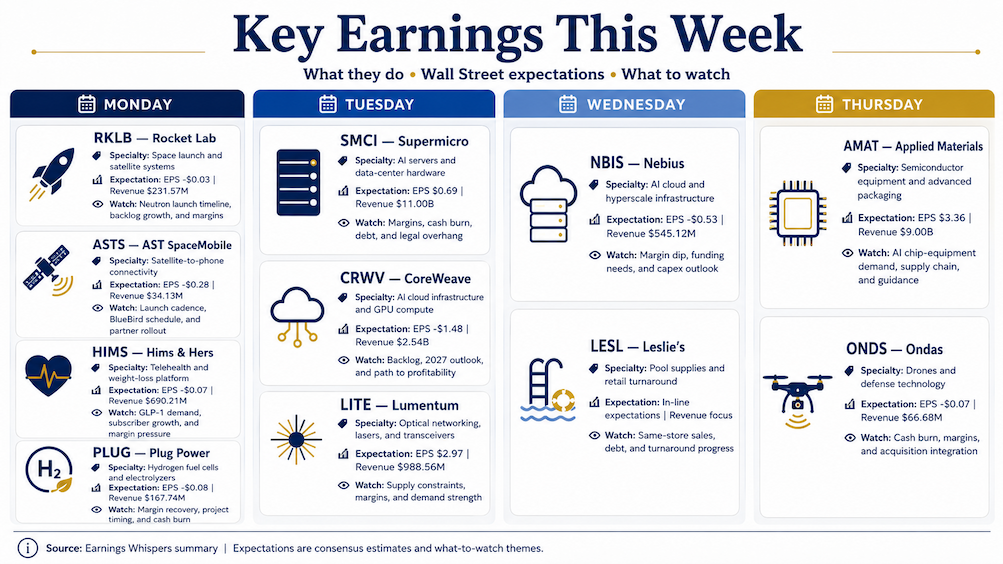
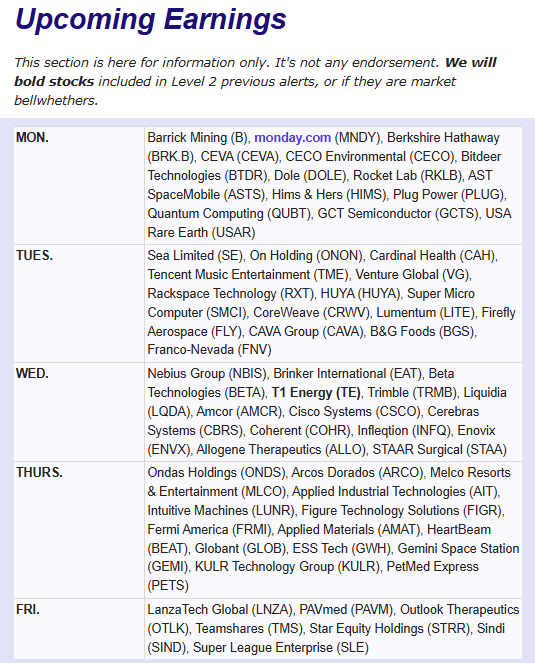
Earnings will keep the AI infrastructure trade in focus. Nebius (NBIS), CoreWeave (CRWV), Lumentum (LITE), Cisco (CSCO), Coherent (COHR), Supermicro (SMCI), and Applied Materials (AMAT) will provide updates on AI compute, networking, optics, servers, and semiconductor equipment. The biggest question is whether demand remains strong enough to justify elevated valuations and continued capital spending.
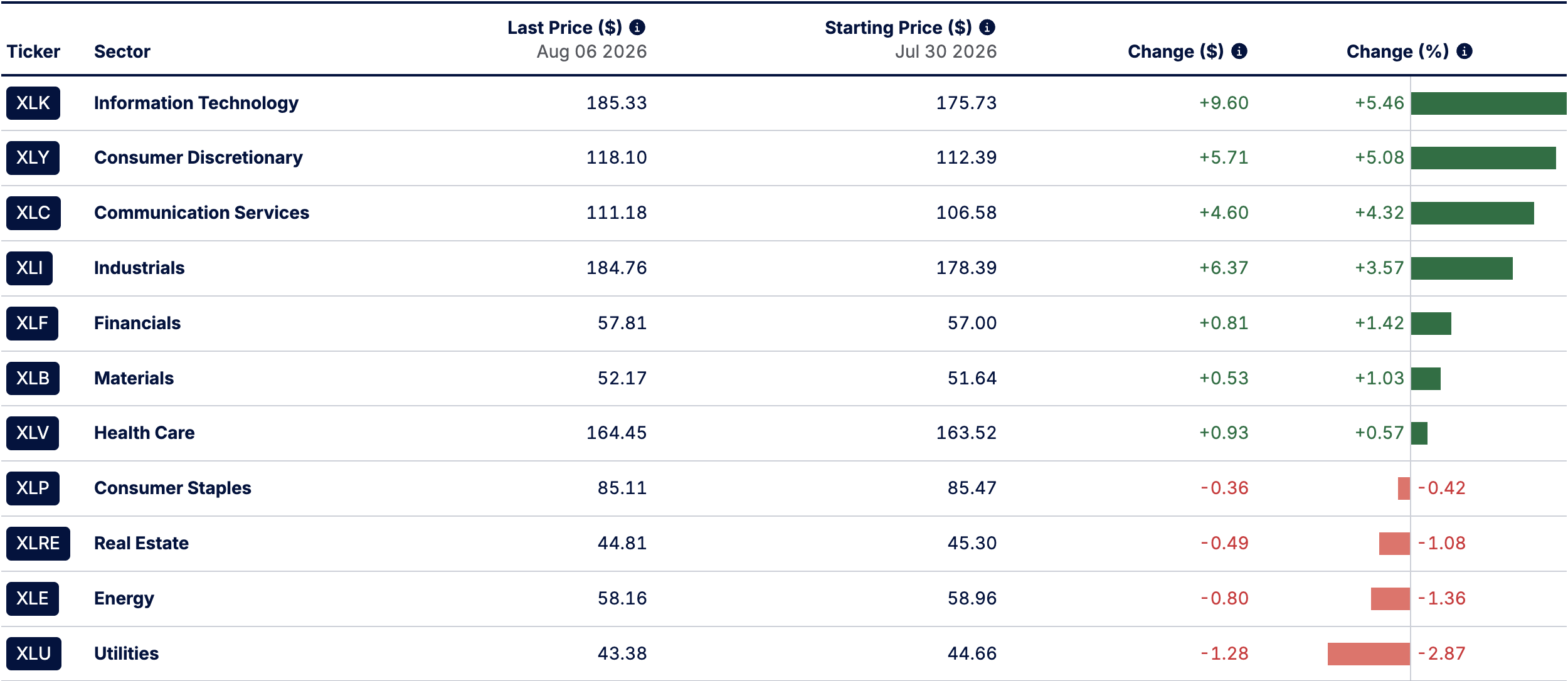
Last week’s sector performance showed a clear return to growth leadership. Technology (XLK +5.46%) led, followed by Consumer Discretionary (XLY +5.08%), Communication Services (XLC +4.32%), and Industrials (XLI +3.57%). Utilities (XLU -2.87%), Energy (XLE -1.36%), Real Estate (XLRE -1.08%), and Consumer Staples (XLP -0.42%) lagged, pointing to a more risk-on market.
The question this week is whether cooling labor data, manageable inflation, and another strong round of AI earnings can extend the rally—or whether a hotter CPI/PPI print forces markets to price in another Fed hike.
The Materials Behind AI, Defense And Robotics Are Back In Focus
Washington’s campaign to reduce U.S. dependence on Chinese critical materials accelerated again this week.
The administration announced billionsof dollars across batteries, rare earths, scandium, magnets, bauxite, boron, and other strategic materials. This builds on a much broader effort that has already included government loans, equity stakes, price floors, long-term purchase agreements, tariffs, and defense contracts.
The goal is simple: reduce China’s leverage over the materials needed to build weapons, batteries, semiconductors, AI infrastructure, and robots.
The effort has been building for more than a year. What is changing now is the scale of capital being deployed and the number of supply chains Washington is willing to support directly.
Why It Matters
Critical materials sit underneath nearly every major investment theme in the market.
Rare-earth magnets power missile systems, drones, EV motors, industrial machinery, and humanoid robot actuators. Graphite and lithium are essential to batteries. Scandium strengthens lightweight alloys used in aircraft. Germanium is used in infrared sensors and advanced electronics. Boron is used in magnets, semiconductors, nuclear applications, and defense.
AI is making the problem more important because demand is now coming from both sides of the technology stack.
Data centers require batteries, power equipment, semiconductors, and networking infrastructure. Physical AI requires motors, actuators, batteries, and large quantities of permanent magnets.
A humanoid robot may require roughly 3.5–4 kilograms of rare-earth magnets, potentially more magnetic material than an EV motor.
Meanwhile, defense demand is rising at the same time as the U.S. works to rebuild missile and air-defense inventories while reducing reliance on Chinese suppliers. This week, talks were revealed between Lockheed Martin (LMT) and NioCorp (NB), Teck Resources (TECK), and 5N Plus (VNP) to secure scandium and germanium supplies outside China, showing how policy pressure is beginning to translate into real procurement decisions.
The result is that defense, AI, robotics, batteries, and electrification are increasingly competing for many of the same materials.
How The Industry Actually Works
The easiest way to understand the opportunity is:
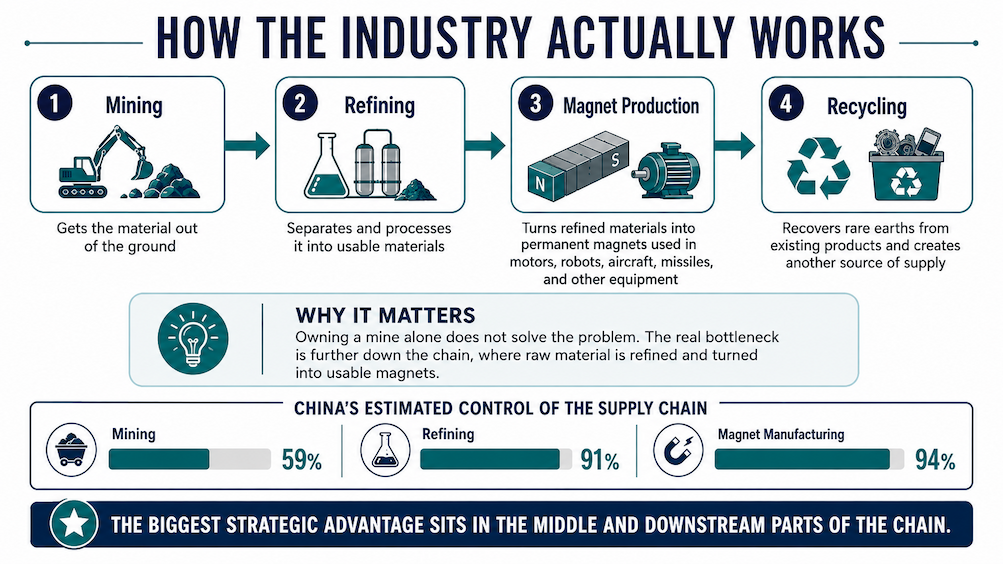
Mining → Refining → Magnet Production → Recycling
Mining gets the material out of the ground.
Refining separates and processes it into the specific materials manufacturers need.
Magnet production turns those refined materials into permanent magnets used inside motors, robots, aircraft, missiles, and other equipment.
Recycling creates another source of supply by recovering rare earths from existing products.
The important point is that simply owning a mine does not solve the problem.
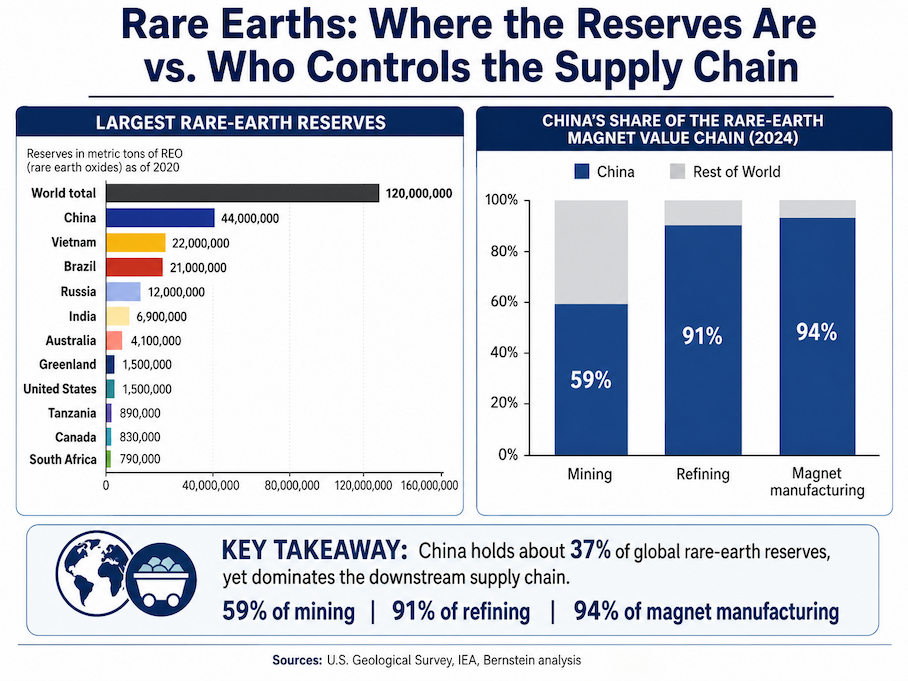
China is estimated to control roughly 59% of magnet rare-earth mining, 91% of refining, and 94% of magnet manufacturing. Its biggest advantage therefore sits in the middle and downstream portions of the supply chain, where raw material becomes something manufacturers can actually use.
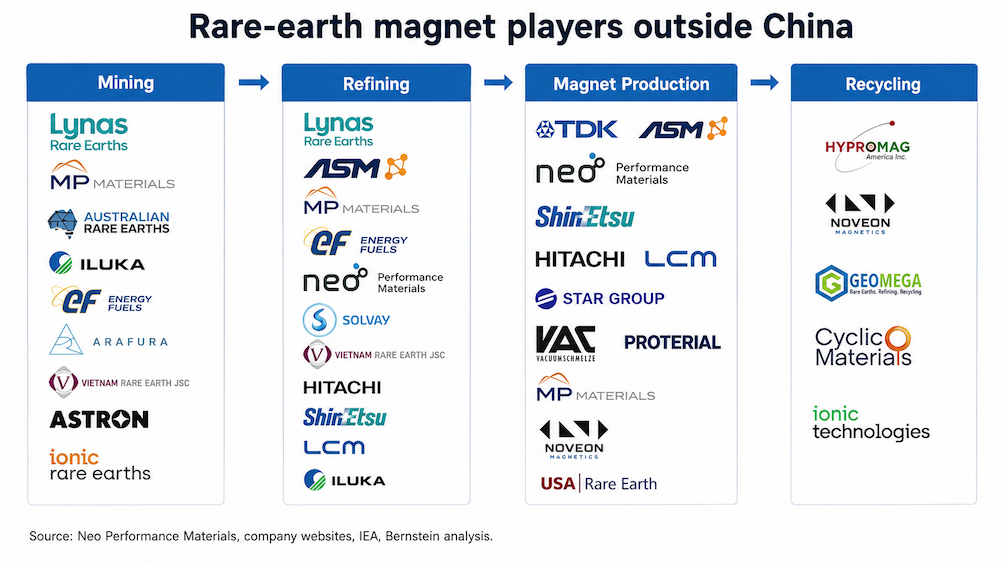
That is why vertically integrated companies are strategically important. MP Materials (MP), for example, already mines, separates, and refines rare earths at Mountain Passwhile expanding domestic magnet production.
Where Washington Is Putting The Money
This is not limited to this week’s announcements. The government has been steadily building positions across different parts of the supply chain.
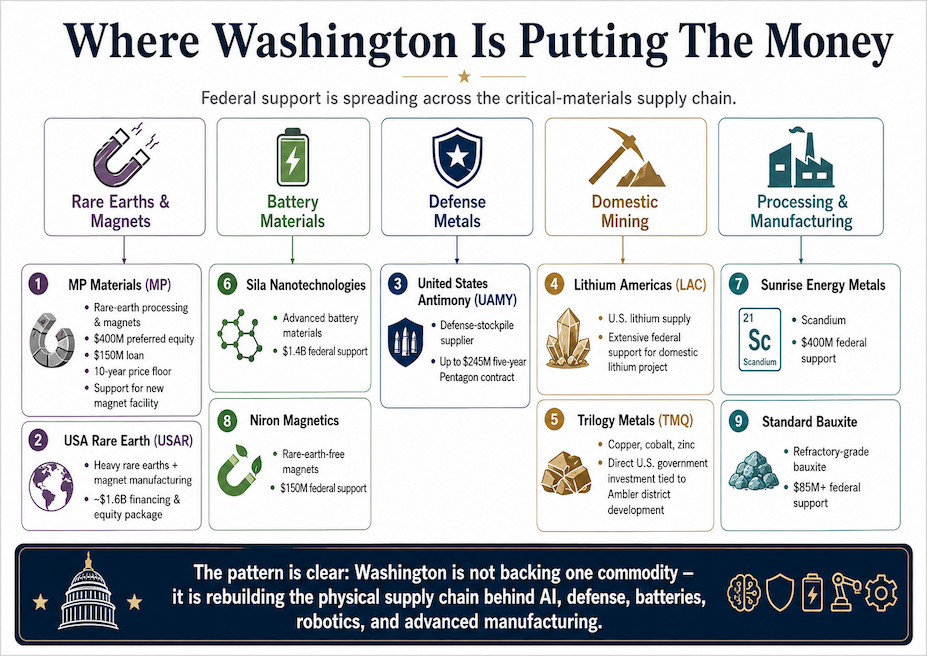
MP Materials (MP) receiveda multibillion-dollar Pentagon-backed package supporting rare-earth processing and magnet manufacturing. The agreement includes a $400 million preferred-equity investment, a $150 million loan, a 10-year price floor, and support for a new magnet facility.
USA Rare Earth (USAR) received a roughly $1.6 billion government financing and equity package to advance its heavy rare-earth project and domestic magnet manufacturing.
United States Antimony (UAMY) secured a five-year Pentagon contract worth up to $245 million to supply antimony for the national defense stockpile.
Lithium Americas (LAC) hasreceived extensive federal supportfor development of its U.S. lithium project, one of the most strategically important domestic battery-material projects. The company also has backing from General Motors, which has invested in the project and signed agreements to help secure a domestic lithium supply chain for EV batteries.
Trilogy Metals (TMQ) received a direct U.S. government investment tied to development of Alaska’s Ambler mining district, which contains copper, cobalt, zinc, and other strategic minerals.
This week added another wave of support, including $1.4 billion for Sila Nanotechnologies, $400 million for Sunrise Energy Metals, $150 million for Niron Magnetics, and more than $85 million for Standard Bauxite.
The pattern is clear: Washington is not picking one commodity. It is trying to rebuild the entire physical supply chain behind AI, defense, batteries, robotics, and advanced manufacturing.
The Plan Of Attack
The key date for this trade is November 10, 2026.
China temporarily suspended several export controls on rare earths, lithium-battery materials, graphite, gallium, germanium, antimony, and related processing technologies as part of the U.S.-China trade truce.
That suspension expires November 10.
This does not mean exports automatically stop the next day, but if negotiations deteriorate, previously suspended restrictions could return.
The market will likely move before the deadline. Any sign that talks are breaking down could quickly increase the value of companies producing strategic materials outside China.
Our approach is therefore to own companies where Washington is already removing financing, processing, or supply bottlenecks rather than simply funding speculative exploration.
The Names We Like
Westwater Resources (WWR) — Graphite
WWR is currently the clearest U.S. graphite trade.
Shares nearly doubled Friday after the U.S. Export-Import Bank committed $25 million to help complete its Alabama graphite facility.
Graphite is the primary material used in lithium-ion battery anodes, yet the U.S. currently has no meaningful domestic natural-graphite production.
More importantly, the federal financing removes a major funding risk.
The stock is extended after Friday's move, so we would look for a better entry rather than chase, but WWR is our preferred higher-risk trade.
Energy Fuels (UUUU) — Processing
UUUU targets what may be the most important bottleneck: domestic refining and processing.
Opening U.S. mines does little good if the material still needs to be sent overseas before manufacturers can use it.
Energy Fuels participates in both mining and rare-earth processing and has received a $725 million conditional federal loan tied to domestic rare-earth development.
If China threatens renewed export controls, processing capacity could become even more valuable.
MP Materials (MP) — Best Core Holding
MP remains one of the highest-quality way to own the theme.
It already operates Mountain Pass, refines rare earths domestically, and is expanding into U.S. magnet manufacturing.
Pentagon financing, a long-term price floor, and magnet purchase commitments substantially reduce the risks faced by most mining companies.
United States Antimony (UAMY) — Defense-Focused
UAMY gives investors direct exposure to antimony, which is used in munitions, batteries, and other defense applications.
The company has a sole-source Pentagon contract worth up to $245 million to supply antimony for the U.S. defense stockpile.
That gives UAMY a much clearer demand catalyst than simply betting on higher commodity prices.
Amprius Technologies (AMPX) — Battery Play
AMPX gives direct exposure to the battery side of the reshoring theme.
The company develops high-energy-density lithium-ion batteries using silicon-based anodes, the same broader battery technology area Washington is now backing through its $1.4 billion commitment to Sila Nanotechnologies.
AMPX was not a direct recipient of this week’s funding, but it fits the same strategic need: building advanced battery capacity outside China for defense, drones, aviation, and other high-performance applications.
Unlike a mining project that may take years to reach production, AMPX already sells batteries, giving it more immediate exposure to rising demand for domestically sourced advanced battery technology.
Last's Weeks Sector Winners & Losers
Sector leadership shifted back toward growth last week. Information Technology (XLK +5.46%) led the market, followed by Consumer Discretionary (XLY +5.08%), Communication Services (XLC +4.32%), and Industrials (XLI +3.57%). Financials (XLF +1.42%), Materials (XLB +1.03%), and Health Care (XLV +0.57%) also finished higher.
The weakest sectors were Utilities (XLU -2.87%), Energy (XLE -1.36%), Real Estate (XLRE -1.08%), and Consumer Staples (XLP -0.42%).
The rotation points to a more risk-on market, with investors moving back into technology, consumer, and communication stocks while defensive sectors lagged. The strength in Industrials and Materials also suggests the rally extended beyond just large-cap technology.
Upcoming Events This Week
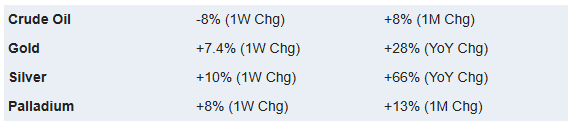
Markets will be focused on Iran negotiations, U.S. inflation data, and another volatile week for the AI trade. Talks between Iran, the U.S., and Gulf states over access to the Strait of Hormuz could continue driving oil prices and interest-rate expectations. In the U.S., July CPI will be the key macro event, with investors also watching PPI, retail sales, consumer sentiment, existing home sales, and small-business optimism as markets and the FOMC remain divided over next month’s rate decision.
Earnings will provide another test for AI-related stocks, with Applied Materials, Cisco, and CoreWeave among the key reports. Overseas, investors will watch UK and Swiss Q2 GDP, Eurozone industrial production, Chinese monetary data, Taiwan GDP, and inflation reports from China and India. The Reserve Bank of Australia and Norges Bank will also announce rate decisions, while the Bank of Japan releases its July Summary of Opinions

LevelFields AI Top Stock Alert Last Week
Telesat (TSAT) +36.0% (1D) — Billion Dollar Contract
Shares of Telesat surged roughly 36% in one day after the company announced a C$2.3 billion contract with Canada’s Defence Investment Agency to provide secure Arctic military satellite communications through its Telesat Lightspeed network. The agreement also includes two five-year option periods worth about C$200 million each, bringing the total potential value to C$2.7 billion. This is the largest contract in Telesat’s history.
The announcement was especially important because it does more than add revenue. It materially expands the scale of the company’s business by allowing Telesat to grow its initial Lightspeed constellation from 156 satellites to 225 satellites, a roughly 44% increase in capacity, with expansion funded through milestone-based payments from the Canadian government beginning in Q3 2026. That significantly strengthens the commercial case for the network while reducing execution and funding concerns.
This Weeks Earnings Focus
Lumentum Earnings: Can The AI Laser Shortage Drive Another Beat?
Lumentum reports Tuesday after the close, with Wall Street expecting roughly $990M in revenue and $2.98 in adjusted EPS, versus company guidance of $960M–$1.01B and $2.85–$3.05.
The setup leans bullish because peer earnings are showing that AI optics demand is still running ahead of supply. AAOI said transceiver demand is 20%–40% above available capacity and identified lasers as the biggest bottleneck. MACOM just reported 35.8% YoY revenue growth and guided Q4 revenue to roughly $420M at the midpoint, implying nearly 61% YoY growth, driven by the 1.6T optical upgrade cycle.
The same strength is showing up upstream. AXT reported 164% revenue growth and said demand for indium phosphide wafers continues to exceed supply even as capacity expands. InP is a critical input for the lasers used in 800G, 1.6T, and next-generation optical systems.
That gives Lumentum a favorable earnings backdrop. Last quarter, revenue reached $808.4M, up 90% YoY, while non-GAAP operating margin hit 32.2%. Management is now guiding to 35%–36%, showing that stronger demand is also translating into operating leverage.
The main question is whether LITE can convert the shortage into another revenue and margin beat. A strong print would likely mean revenue above $1B, EPS above $3.00, and guidance confirming continued strength in 800G, 1.6T, lasers, CPO, and optical circuit switches.
The biggest risk is supply, not demand. Lumentum has already said it cannot make enough pump lasers and EML chips to satisfy customers, so the key watch is whether capacity constraints limit how much upside the company can capture.
Given the readthroughs from AAOI, MACOM, and AXT, the setup supports the possibility of another strong quarter, but with expectations already elevated, the forward guide will matter more than the headline beat itself.
.png)
How to use LevelFields for Options Trading
Tracking Stocks Without Spreadsheets
The Truth About Dividend Stocks
What's LevelFields' Premium Membership Provide?
This is not financial advice. All information represent opinions only for informational purposes. Given the vast number of stocks we cover in these reports, assume staff covering stocks have positions in stocks discussed.
Have feedback or a request for specific data? Drop us a note at support@levelfields.ai