


.png)
L2 Weekly Stock Market News Analysis
August 16th, 2026
TLDR:
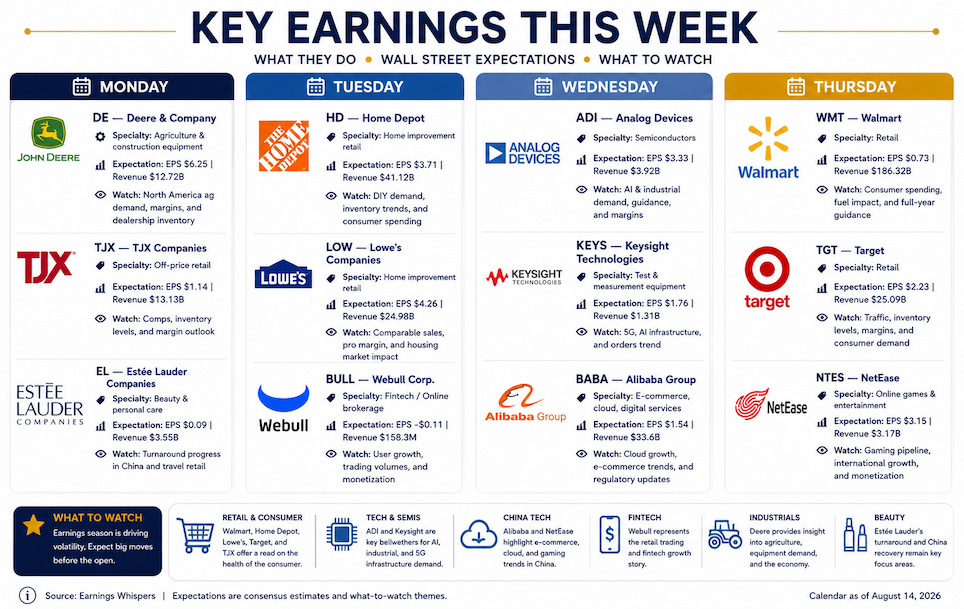
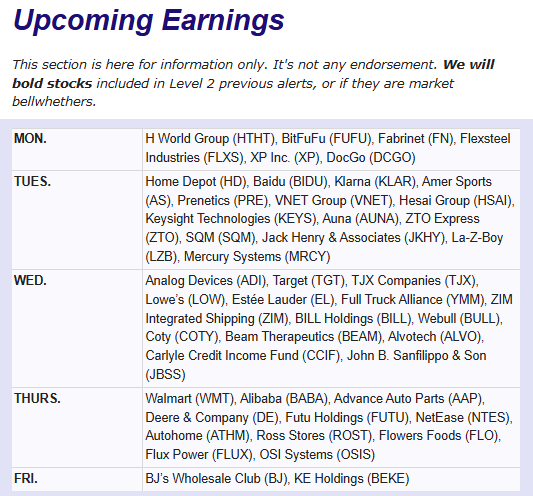
The biggest story this week is the consumer and the Fed. Home Depot (HD), Target (TGT), TJX Companies (TJX), and Walmart (WMT) all report earnings, giving investors a broad read on spending across home improvement, middle-income consumers, value shoppers, and lower-income households. The key will be what management teams say about traffic, basket sizes, pricing, margins, and whether consumers are trading down.
Wednesday’s FOMC minutes will be the main macro event, giving investors more detail on the Fed’s decision to hold rates and the disagreement inside the committee. Markets will be watching for clues on how policymakers are balancing persistent inflation against slowing growth, with particular focus on whether the Fed remains open to further tightening or is becoming more comfortable staying on hold.
Economic data will also provide an important read on momentum. Thursday brings initial jobless claims and the Philadelphia Fed Manufacturing Index, while Friday’s preliminary S&P Global Manufacturing and Services PMIs will show whether business activity is holding up heading into late summer.
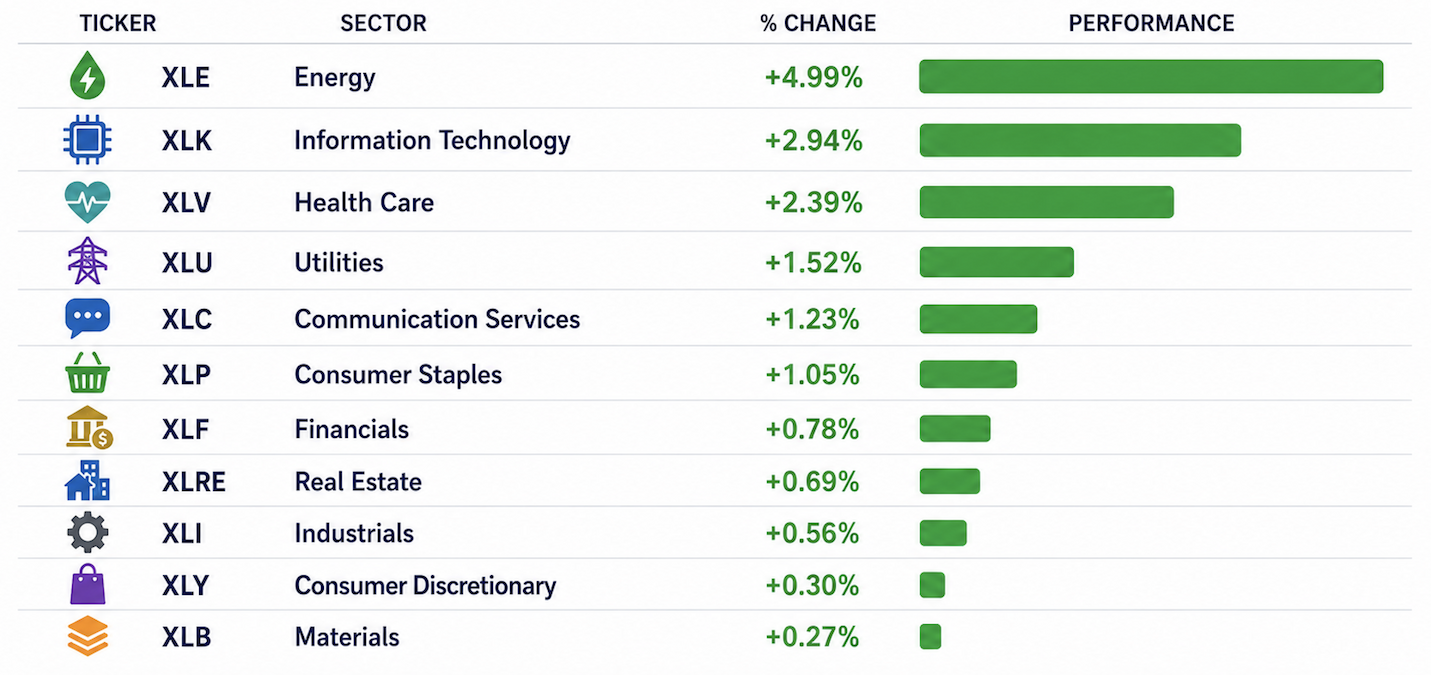
Last week’s sector performance was broadly positive, with every major sector finishing higher. Energy (XLE +4.99%) led the market, followed by Information Technology (XLK +2.94%), Health Care (XLV +2.39%), and Utilities (XLU +1.52%). Communication Services (XLC +1.23%) and Consumer Staples (XLP +1.05%) also gained, while Financials (XLF +0.78%), Real Estate (XLRE +0.69%), Industrials (XLI +0.56%), Consumer Discretionary (XLY +0.30%), and Materials (XLB +0.27%) lagged but still finished higher.
The question this week is whether retail earnings can confirm that consumer spending remains resilient while the Fed stays patient.
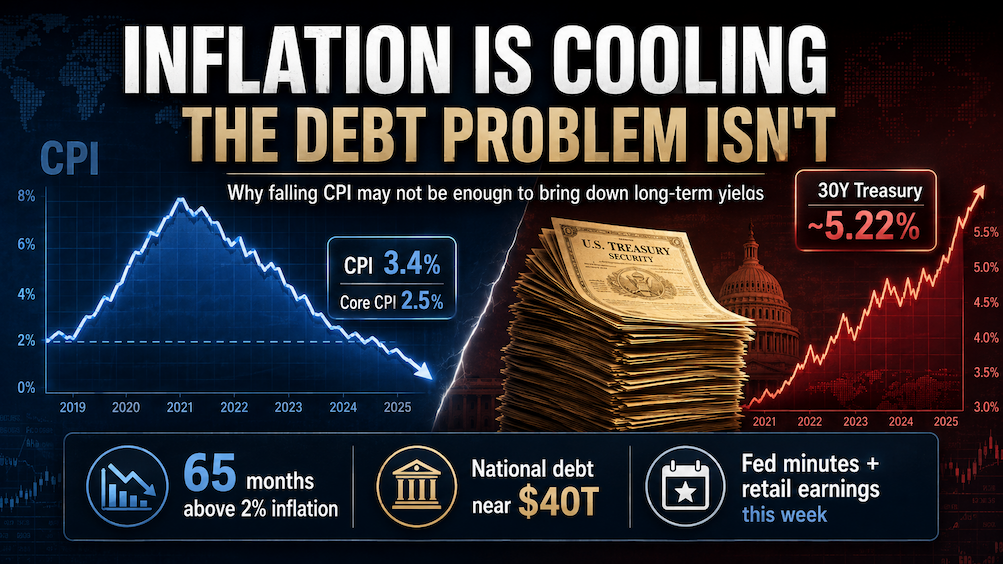
Inflation Is Cooling. The Debt Problem Isn’t.
Inflation moved in the right direction this week.
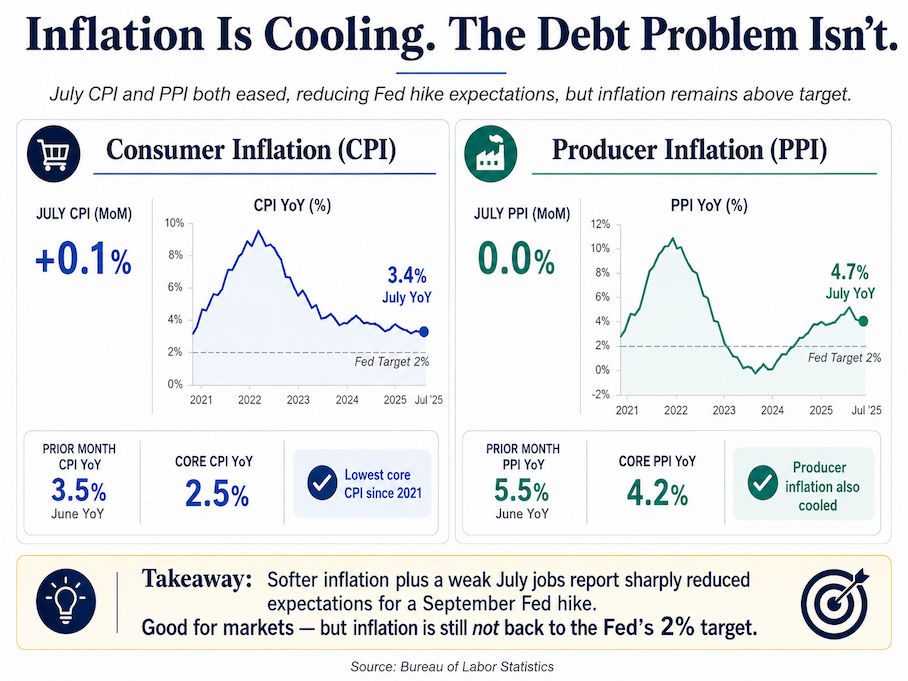
July CPI rose just 0.1% month over month and 3.4% year over year, down from 3.5% in June. Core CPI slowed to 2.5%, its lowest annual rate since 2021.
Producer prices told a similar story. July PPI was flat month over month, while annual producer inflation fell from 5.5% to 4.7%. Core PPI also slowed to 4.2%.
The combination of softer inflation and July's weak employmentreport sharply reduced expectations for another Fed hike in September.
That is good news for markets.
But it does not mean the inflation problem is over.
65 Months Above 2%
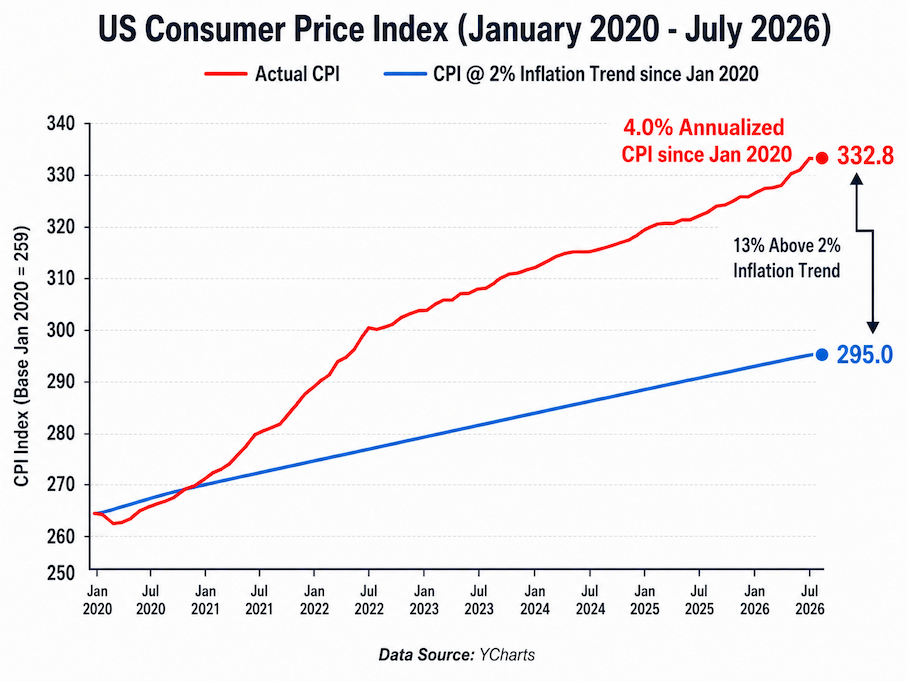
July marked the 65th consecutive month that headline CPI inflation has remained above 2%.
The streak began in March 2021, when CPI jumped to 2.6% from 1.7% the month before. More than five years later,inflation is still running at 3.4%.
The Fed technically targets PCE inflation, not CPI, but the broader point is the same: inflation has remained persistently above the level policymakers consider consistent with price stability. The Fed's own preferred measure also remains above its 2% objective.
There is also an important distinction between lower inflation and lower prices.
When inflation falls from 5% to 3%, prices are not reversing. They are simply rising more slowly.
That means households are still living with the cumulative price increases of the past five years even as monthly inflation reports improve.
The market is focused on the rate of change. Consumers are living with the price level.
The Bigger Problem Is Debt
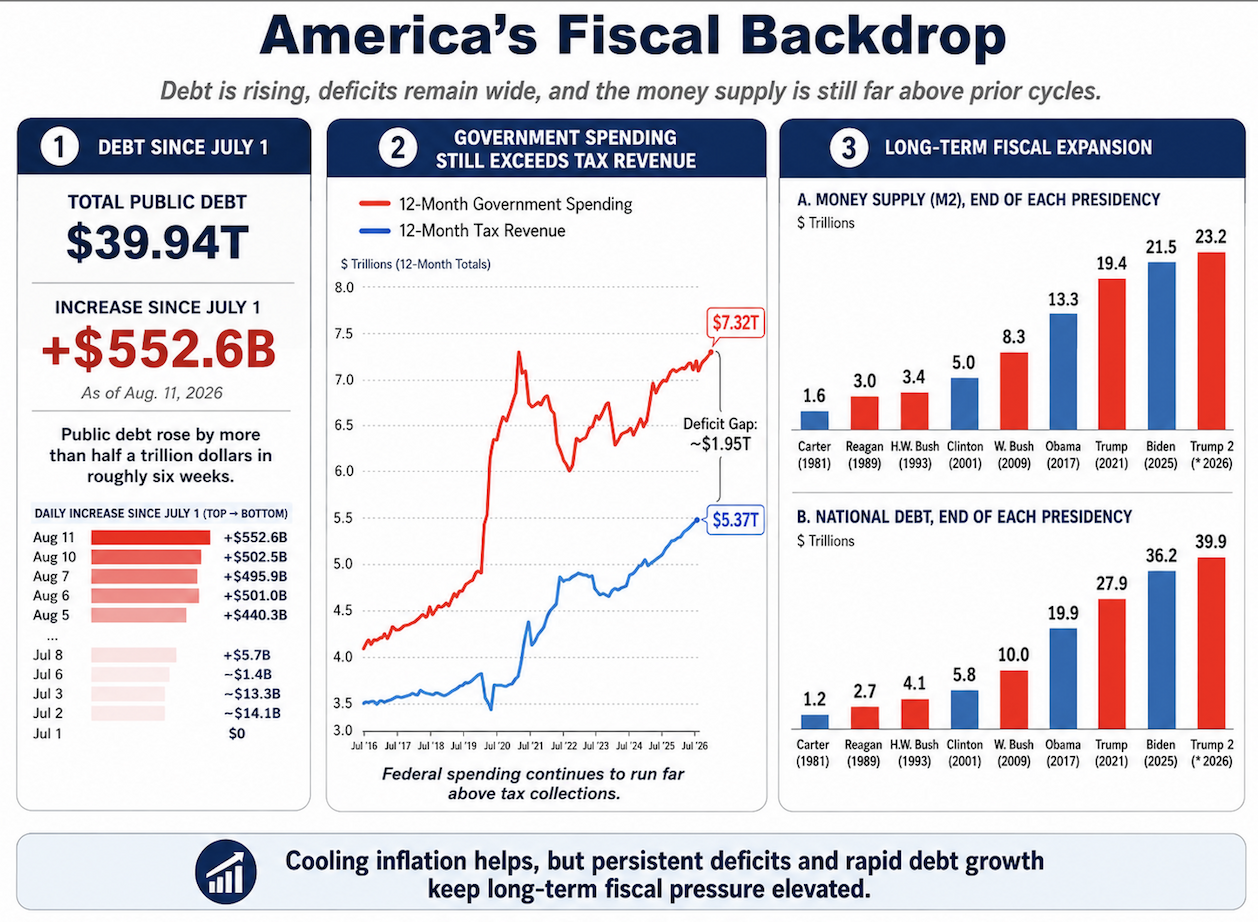
The more important long-term issue may now be what persistent inflation means for a government carrying nearly $40 trillion of debt.
Washington ran a record $432 billion budget deficit in July, pushing the fiscal 2026 deficit to $1.799 trillionwith two months still remaining in the fiscal year. That already exceeds the entire $1.775 trillion deficit recorded in fiscal 2025.
Gross federal debt stood near $39.4 trillion in early July and is now approaching $40 trillion.
The problem is not simply the amount of debt. It is the cost of financing it.
This week, the Treasury sold 30-year bonds at a yield of roughly 5.22%—the highest auction yield since 2001.
This is not a Treasury funding crisis. Investors are still buying the debt.
The issue is the price they are demanding to own it.
The mechanics are simple:
Large Deficits → More Treasury Issuance → Higher Interest Costs → Larger Deficits → More Borrowing
Every new bond issued at today's rates is more expensive than debt issued when rates were near zero.
Bank of America estimatesannual U.S. debt-service costs have already climbed to roughly $1.5 trillion.
That creates an increasingly difficult cycle. Cutting rates would reduce financing costs over time, but easing monetary policy too quickly could revive inflation. Keeping rates high helps fight inflation but makes the government's debt burden more expensive.
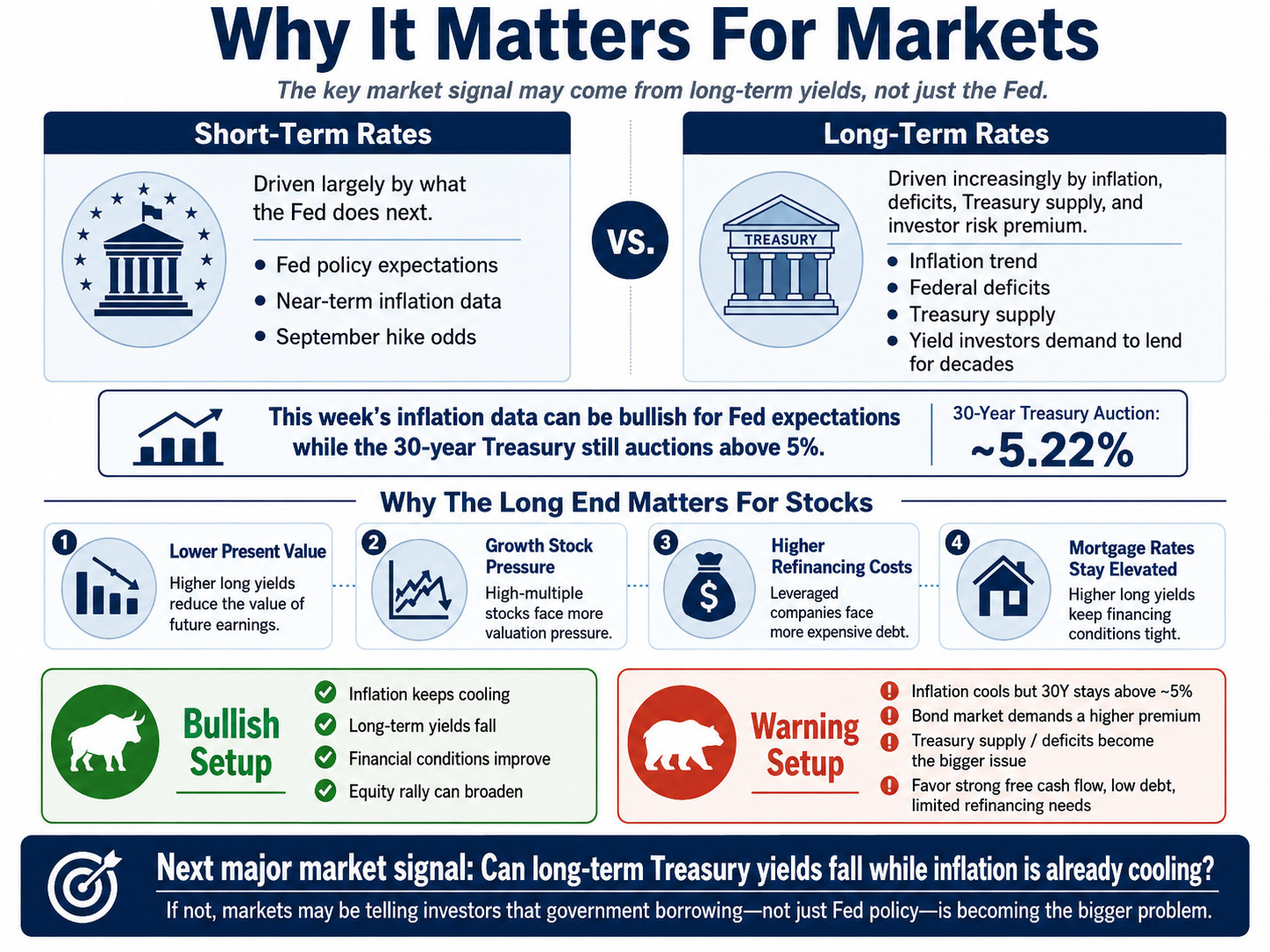
Why It Matters For Markets
This creates an important disconnect.
Short-term rates are largely about what the Fed does next.
Long-term rates increasingly reflect inflation, deficits, Treasury supply, and how much investors need to be paid to lend Washington money for decades.
That is why this week's inflation data can be bullish for Fed expectations while the 30-year Treasury still auctions above 5%.
For stocks, the long end matters enormously. Higher Treasury yields reduce the present value of future earnings, pressure high-multiple growth stocks, raise refinancing costs for leveraged companies, and keep mortgage rates elevated.
The 30-year auction near 5.22% provides a useful reference point. If long-term yields begin falling alongside inflation, financial conditions improve and the equity rally has room to broaden.
If the 30-year remains above roughly 5% despite softer inflation, the bond market is sending a different message: investors still require a large premium to absorb growing Treasury supply. That environment favors companies with strong free cash flow, low debt, and limited refinancing needs over businesses whose valuations depend on cheap capital.
The next major market signal may therefore not come from whether the Fed raises rates another 25 basis points. It may come from whether long-term Treasury yields can fall when inflation is already cooling.
If inflation falls but long yields stay elevated, the market may be signaling that government borrowing and Treasury supply—not just Fed policy—are becoming the bigger problem.
Last's Weeks Sector Winners & Losers
Sector performance was broadly positive last week, with every major sector finishing higher. Energy (XLE +4.99%) led the market, followed by Information Technology (XLK +2.94%), Health Care (XLV +2.39%), and Utilities (XLU +1.52%). Communication Services (XLC +1.23%) and Consumer Staples (XLP +1.05%) also posted solid gains.
Financials (XLF +0.78%), Real Estate (XLRE +0.69%), Industrials (XLI +0.56%), Consumer Discretionary (XLY +0.30%), and Materials (XLB +0.27%) finished higher but lagged the broader market.
The biggest takeaway is the breadth of the rally. Leadership was split between growth areas like Technology and Communication Services and more defensive sectors like Health Care and Utilities, while Energy was the clear outperformer.
Upcoming Events This Week
Markets will be focused on Iran, interest rates, and signs of consumer strength this week. The standstill between Iran and the U.S. remains a key driver of energy prices and global yields, especially after Washington signaled continued economic pressure rather than a shift toward diplomacy. Investors will also watch the Federal Reserve minutes from its latest meeting, which included three hawkish dissents, along with ECB meeting accounts.
In the U.S., the main economic releases include flash S&P PMIs, industrial production, building permits, housing starts, pending home sales, import and export prices, and regional manufacturing surveys. Treasury yields will remain especially important as markets weigh both geopolitical risk and the possibility of a more divided Fed.
Earnings will slow but still provide useful readthroughs on the economy. Walmart, Home Depot, TJX, Lowe’s, and Target will offer a fresh look at consumer spending, while Analog Devices will provide another update on semiconductor and AI-related demand.

LevelFields AI Top Stock Alert Last Week
H&R Block (HRB) +16.0% (1D) — Dividend Increase & Strong Results
Shares of H&R Block jumped roughly 16% in one day after the company reported fiscal 2026 results and raised its quarterly dividend by 10%, marking its ninth consecutive annual increase. HRB also returned $713.7 million to shareholders through dividends and buybacks during the year.
The dividend increase was backed by improving fundamentals. Revenue rose 4.9% to $3.95 billion, adjusted EPS increased 13.9% to $5.31, and operating cash flow grew 23%. Management also guided fiscal 2027 adjusted EPS to $6.04–$6.24, signaling continued earnings growth alongside aggressive capital returns.
Last Weeks Earnings Focus
Lumentum Earnings Confirmed The AI Optics Shortage
Last week’s earnings focus was Lumentum (LITE), where the setup pointed to another strong quarter as demand for AI networking equipment continued to outpace supply.
The results were even stronger than expected, and shares jumped more than 10% following earnings.
Revenue reached $1.01 billion, up 109% YoY and 24.5% sequentially, versus roughly $985 million expected. Adjusted EPS came in at $3.23 versus roughly $2.97 expected, while operating margin expanded to 36.6%.
The guidance was even more important. Lumentum expects Q1 FY2027 revenue of $1.225–$1.275 billion, well above the roughly $1.16 billion consensus, with adjusted EPS of $4.05–$4.35 versus roughly $3.61 expected. Operating margin is expected to rise again to 39.5%–40.5%.
That means quarterly revenue is moving from roughly:
$808M → $1.01B → ~$1.25B
while profitability continues improving at the same time.
Management also said demand is increasing for the high-powered lasers used in next-generation AI data centers. More importantly, optical technology is beginning to move deeper inside AI servers and racks, which could significantly expand the amount of Lumentum equipment needed in each data center.
The bigger takeaway is that the supply shortage highlighted before earnings is now showing up directly in faster revenue growth, higher margins, and stronger guidance. Lumentum is reaching its long-term financial targets earlier than expected, suggesting the AI optics boom is still accelerating.
This Weeks Earnings Focus
Target Earnings: A Beat May Not Be Enough
Target reports Wednesday before the open, with Wall Street expecting roughly $26.0B in revenue and $2.26 in EPS, while the whisper number sits slightly higher at $2.35. The stock has already gained about 28.5% since its last report, raising the bar for another positive reaction.
The setup supports the possibility of another modest beat.Last quarter, comparable sales grew 5.6% and net sales increased 6.7%, driven by stronger traffic, digital sales, and growth across every major merchandise category. Target subsequently raised its 2026 sales outlook to roughly 4% growth and said full-year EPS should land near the high end of its $7.50–$8.50 range.
There is also a potential one-time catalyst from tariff refunds. Target may be eligible for as much as $2.2 billion in refunds tied to tariffs struck down earlier this year. Importantly, Target's existing 2026 guidance explicitly excludes any benefit from tariff refunds, meaning any recognized refund could provide additional earnings or cash-flow upside beyond the company's current forecast. The timing and accounting treatment remain uncertain, so this should be viewed as potential upside rather than guaranteed Q2 earnings.
The bigger issue is what comes next. This quarter carries Target's toughest comparison of the year, while fading tax-refund spending and a more cautious consumer could slow the momentum seen in Q1. Target has already indicated that growth should moderate after the strong start to the year.
That creates a setup where the headline numbers could look fine while the stock still falls. A modest revenue or EPS beat—especially if helped by non-recurring items—would matter less than commentary on comparable sales, traffic, margins, and second-half consumer demand.
The key risk is guidance. With shares already up sharply since the last report, investors will likely want confirmation that Q1's rebound was sustainable. If Target beats the quarter but guides toward roughly 1% sales growth for the remainder of the year or warns of weaker consumer demand, the stock could sell off despite the headline beat.
The most important number Wednesday may therefore not be EPS. It will be how much underlying sales growth Target expects once the easy catalysts and potential tariff benefits are stripped away.
.png)
How to use LevelFields for Options Trading
Tracking Stocks Without Spreadsheets
The Truth About Dividend Stocks
What's LevelFields' Premium Membership Provide?
This is not financial advice. All information represent opinions only for informational purposes. Given the vast number of stocks we cover in these reports, assume staff covering stocks have positions in stocks discussed.
Have feedback or a request for specific data? Drop us a note at support@levelfields.ai